The Tale of the Three Sons of Cwendor
or
Neirenye and the Faery Queen
Very well, said Naiwe, I shall tell a tale that has been handed down through my father’s line for time almost beyond memory. It is a strange story, and sad; yet my father when I was a child told me that by these signs we know it is true. Perhaps it is so; I do not know. That will be for each man of you to decide for himself.
There was once a very many years ago only two kingdoms in all the world, and one was ruled by a man named Cwendor. He was a mighty king, proud and strong, and yet his power had rotted within him like dead flesh, and all his mind was turned wholly to evil. His wife had been a fair, gentle creature, but had died young, so that he lived alone in his palace of cold stone, and her name is not recorded here. The only other living things in that palace were his men-at-arms, and his knights, and these were as wicked as he. And there lived also his three sons, borne to him by his unhappy wife ere she died, but he did not love them.
Now the other kingdom of the world at this time was the Fay land, and it was ruled by a Queen. This Queen (or so my father said) was the most beautiful lady ever to walk the earth, and the magic within her glowed from her eyes and her fingers, and when she sang the colors of the sky bent to listen, and when her anger was roused the sea fled from her. For she was the Queen of Faery, and Faery is beautiful, but also perilous.
Now this Queen—and she has no name in the old stories—would gaze from her tower window to survey the world, for Faery, as all children know, is a kingdom unique in this world. For during the day, it has boundaries and borders as any land, and may be found or lost; yet at night the Fay world grows to swallow all the world in its power, and then is the Queen ruler of all the earth. And she would look out, and behold the kingdom of Cwendor with its slender towers like spires and ribbons, and its mighty walls, and gentle peasant folk, and shining halls, and she would see the trees of that kingdom dancing in the wind, and the strange and silent beasts running through the darkness, and she was pleased.
One thing only in all the mortal kingdom displeased the Queen, and this was the evildoing of Cwendor and the men of his house. Glad forests of fair trees were burned and their cries were drowned in the smoke; silently children of the poor wept for hunger, and their parents stood dry-eyed and dumb-mouthed when the knights of the king stole their goods away. Dark-clotted blood stained the torn earth where Cwendor’s cruel game-hunts ended, for he hunted and pursued beasts of the wood and field for his own amusement, and left the bodies to rot upon the young grass. Murder and deception whispered about his feet; fear and vanity followed him like a shadow, and the moaning of the condemned racked within his prisons no one heard.
No one save only the Queen of Faery, and she heard and saw all.
It was summer, and the night was soft and silent, and the Queen looked out from her high casement upon a world of charcoal and lavender. Yet in the gloaming glamor she heard a living voice, and she stood listening in amaze, for long had she deplored the muted and burdened agony of the people of Cwendor, and the wailing of the fields and the hills no ear heard but hers alone.
This voice was that of a boy, or a very young man, and it cried words of defiance and anger, and of a sudden steel rang. The Queen looked then to see the twilit silhouettes of a shepherd lad standing before a hut, and the shapes of three of Cwendor’s men tall before him, and they brandished forth long swords, and he a knife, and these glittered like stars in shadowy black hands of the youth and the men.
The Queen looked, and just in time to see the boy slain.
He fell and lay upon the black earth in his blood, and an old man who was his father watched silently as the knights of Cwendor stepped over the body of his son and led away a great part of the flock which had been in pasture, and they departed. But another boy ran up from the darkness, and threw himself weeping upon the body of the slain youth.
And the Queen knew then that the murdered shepherd had a brother.
Then was she wroth indeed, and the blood of the slain boy rang within her as his living voice had done, and she knew the king’s cruelty could no longer be borne. And so she departed from her window, and descended instead to her gardens. Very fair are the gardens of Faery, filled with scents and dreams to bewilder mortal mind, soft and quiet as a mist. And in the center is a pool of silver like a mirror.
It was to this pool that the Queen of Faery went, with her mind filled with steel and kindled fury, and there she worked such magics as had never been worked before, in that distant dawn of the world, and only seldom have been wrought since. For she took from her body her own living mind and spirit, and called to her the winds of the sea, and upon their white wings sent her soul flying across the dreaming beauty of Faery, and the shining waters, and fair forests, and across the green border to the mortal world, and thence to the very chamber of Cwendor, where he lay in deepest sleep.
Into that sleep she entered, and with her all the fire and beauty and power of the Fay country, and pierced his dreaming with her own being, wrathful and terrible and beautiful beyond all mortal understanding. She seemed to him tall and silver and ruthless as a sword unsheathed, and a great wind whipped round her, and her hair flew.
She stood gazing into his mind all that night, reading the malice and the evil and the fear there. Her silence was a flood and a terror to him, and in her steady eyes he read the full tale of his own wickedness, and the cries of all those he had destroyed--bird, beast, tree, hill, and above all the helpless defiance of the shepherd boy. And still she did not speak, and dawn came.
Yet ere she fled his dreaming she spoke five words, as her body melted into the wind of cold awakening, and only her eyes were left, burning, and her voice, burning, and she was the most beautiful woman to be since the beginning of the world.
She said, “O Cwendor, beware of Faery.”
When the Queen returned to her own land and her own body a great weariness was upon her, for to enter the dreaming of a mortal whose mind is shut is the most perilous and arduous of all things which magic can do, and this was the first time it had ever been done, and weariness was a thing strange to the Queen. So she betook herself to a glade of willows, where fireflies drowsed and little breezes played before embarking on their journeys to the sea, and there she laid herself down to sleep, that she might regain her strength. Deep and dreamless was her sleep, for immortals do not dream. And her maidens knelt and kept watch.
But Cwendor awoke in a frenzy of fear, and anger, and he stared about himself like a wild creature, the silver and ice of the woman’s voice ringing in his memory. She was gone, yet her voice remained. In his madness, only that voice was left, and the words spoken by that voice, that voice like a song of swords.
“O Cwendor, beware of Faery.”
The words filled his mind and consumed his thought, and yet rather than heed the warning he acted as a wild wolf would act when cornered.
He summoned to himself his knights.
It was day, and the sun blazed forth in a silver, misty sky, when the Queen awoke. Her maidens still knelt by, silently guarding, and the glade was silent, and nothing had changed. But the Queen looked about herself and said, “I dreamed.”
And she said, “And it seemed to me that I heard a great cry, and then only emptiness, a great emptiness.” She looked about her with her great eyes like bright moons, and she said, “I am burning, I am burning--” and she shivered like a dragonfly and leapt to her feet and went from the glade, making for the border, and her maidens followed.
She went to the green woods of Dor-Aelen, which grew then closest to the borders of the Fay land and that of the mortal people, and there dwelt there as guardians of the wood seven men of the Queen’s household, the fairest of her people and closest to her heart, and they lived there in the merry wood. Their songs in the sunlight carried sometimes to the mortal kingdom, and all men were glad who heard them, yet did not know why. It was here the Queen hastened, and of here the Queen had dreamed, she who of all living things never dreamt.
And there were the trees like ashen smoke, crumbling in the cleansing wind; and there rose a great reek of misery and blood and fire such as Faery had never known, poisonous and foul; and there lay the seven fairest knights of her house, pale and cold upon the stricken ground where they had fought valiantly for their Queen.
Then did the garlanded maidens and shining women of the Fay court set up a loud keening and wailing, and they wept for that immortal blood shed, and the darkening of Faery. And the song of sorrow which they sang flew as a freezing wind through the mortal kingdom of Cwendor, and in his great hall the king in the midst of his exultation shivered, and did not know why.
But the Queen was silent, and shed no tear, but knelt before each of her kinsmen slain, and silent kissed each death wound which had been suffered for her sake.
Now the day drew onward in the mortal kingdom, where Cwendor and his men feasted and made merry over their success in the wood. For so arrogant had the king become, and to such desperation had his dream of warning driven him, that he had led a raid against the Fay kingdom, and set fire to the wood, and with great slaughter of his own men had at last slain the seven knights of Dor-Aelen. Flushed with his triumph, he thought not of the Queen, nor of the reckoning to come, but only that he had shown he was strong, and he no longer feared Faery.
Yet still darkness came, and the subtle night crept up from the sea and the hills, and lamps were kindled against the stars in the palace of Cwendor.
Upon the hillside in a place that was then called Merwon, there wandered a number of sheep, though less than had been there before, and watching them stood a boy of seventeen summers. And the boy’s name was Ebon. He stood guarding his flock, and facing Faery he sang a verse:
I knew a man named Ameron,
Knight-hearted, whom they killed;
His flock they stole away in blood
And me they left behind.
For this was the boy who had wept upon his brother’s corse, and the brother’s name had been Ameron.
As he sang in grief and anger there came to him like a fearsome light a woman, and she was a forest, and a great salt-wave from the sea, and ice from the mountains, and a battlecry, and yet fairer and more perilous than all of these, and she stood upon the grey grass and the sheep knelt at her feet and shone like lambs, and she was the most beautiful woman in the world.
And she spoke to the boy, saying:
“Lo! I am she who is Queen of Faery, and you sang and called to me, and I have come. For I saw your brother and his death, and I know the men who slew him and the man who sent them. And now mine own kinsmen have they also murdered, and my woods set aflame. Come with me, then! and you I shall make king to rule in his place. For now has come the time of reckoning, and there are many hours yet until the dawn.”
The fire that burned in the heart of the youth leapt up in answer, and glad and amazed he vowed his allegiance. And yet this was not enough for the Queen, for she spoke further and said that she would with him go to the palace and that very night take vengeance for the spoiling of her land, and the vengeance would be eternal and upon Cwendor and all that was his. And vengeance she would take also for the death of Ameron and the theft of his livelihood, and set Ebon himself upon Cwendor’s throne, and a king beloved of Faery shall not come to grief. Yet first she would have him swear to do her bidding in all things, without protest, and to obey her word and honor her will. And this he swore eagerly.
He swore the oath, and she stretched out her hand to accept it, and with her fingertips touched lightly his brow, and then time froze, and a great light arose about the two motionless figures upon the hillside.
When Ebon next drew breath he found himself standing in a great courtyard, and this was the court of Cwendor’s own palace, for the guards upon the walls were all asleep. That was Faery magic.
Before him stood the Queen, and in her hands she bore a mantle of shining white, which she commanded him to don. And he obeyed.
Then she took in her hands a crown of silver and misty jewels, and told him to set it upon his own head. And he obeyed.
And last she held out to him a great sword, which shone like a thousand stars, and this she girt upon him with her own hands.
And lordly now indeed was Ebon the shepherd’s son, the chosen one of the Faery Queen. All around him sudden thronged a mighty battle host, of men with silver eyes and clothed in silver mail, and their banners were white. Each bore a sword and each had his hair free, and flowing black in a wind that Ebon could not feel. These were the people of the Fay kingdom, who had come at the Queen’s bidding, and it was with these silent warriors that Ebon rushed upon the palace of Cwendor king of the mortals.
Cwendor’s knights were thus taken unawares, and were all of them slain, some by the enchanted steel, and some by terror. Ebon himself searched the hall of feasting for the king, and yet could not find him. Straightway then he sped up the darkened stairs from the great hall like a star and burst open the door to Cwendor’s chamber, and sprang within with sword upheld.
Yet he was too late. For there before him stood the Queen, and at her feet, writhing in the last throes of death, lay Cwendor. When he first heard the clamor in the hall below he knew his peril, and knew at last that Faery and its Queen had come for him. In his terror he had then gone to the chest where he kept such things and had drunk deadliest poison, and so expired.
Ebon, sick at how the king had taken his own life craven and perished by venom, lowered his blade and would have turned away. Yet the Queen then spoke.
“A swift death.” Her voice was like the singing of the wind in the cold grass. “And the merry wood, in flames. That death will be slow, ah, that death will never end. It has sickened. I can keep it alive. But never shall it be what it was. Never. Of all my kingdom, that place only has known death. It will die forever.
“Bring to me the children.”
So Ebon went forth from that high place and descended to the living quarters of the palace, where all about there lay men like shrouds, and standing over each a flaming shadow of white. And at last he came to a small stone chamber, hung with tapestry woven by the young queen who was dead, and with one window, and a tallow candle burning beside the door. It was here that the heirs of Cwendor slept.
And there he found the three sons of Cwendor, and seized them, and brought them to the Queen. And that most beautiful lady smiled when she saw them, but her eyes glittered as she remembered the fires in the sweet forests of Dor-Aelen, and the blood upon her hands.
Then she bade all men leave the high tower, save only Ebon himself, but he covered his face with fear. For very tall had she become, and masterful, and her eyes were like crystal, and her hair was harpstrings, but her song was a sword and the tolling of an awful bell, and the wind ran through her and the moon drowned in her. And she spoke and sang softly words of power, thrice only, for there were three sons, and her words were for them alone, that the revenge of Faery upon Cwendor and all his line and deeds might be full, and the mark of the Fay curse upon them burned in their eyes everafter.
Then she departed, for the stars were flickering like embers in the grey sky, and day was stirring. But first she commanded her new king to cast the three sons from the palace “that they might come never more to the dwelling places of men, and the last of the royal line perish utterly.”
This, however, Ebon did not do. For when she had gone, and he stood alone in that high chamber, he looked upon the three sons of Cwendor and pitied them, for the eldest was not yet seven years of age, and the Fay light in their eyes haunted him. He took them therefore upon his horse, and rode secretly forth in the cold dawn, until he came to the house of his father, and without a word he left the children there, and wheeled his horse about in haste to the palace, and in all his life did not return.
When Ebon had been king nigh on five years, he wedded a noblewoman of high rank, and she bore him one child. He was well loved by the people, and lived a full, peaceful life, and made the purpose of his whole reign to bring joy to his subjects. Yet he died younger than was the wont of the men of that ancient line. Some say it was because of his having seen the great Lady in wrath, and that when she touched him that night upon the hillside she so harrowed his spirit that it surged ever after within him, aching to be free.
Be that as it may, when his last illness came upon him he had been king for close on thirty years. And he summoned to him his wife, and his knights and lords, and his child—and she was a daughter, but more I shall not tell yet—and they stood all before him, silent.
And the king upon his throne smiled sadly as he gazed upon those beloved faces, and felt his death, wild and glad, surging within him, and the crown heavy upon his brow. And he cried: “O my people! I have served thee long and striven always to do what is best for you. Yet if ever I have made your hearts glad—if ever I have driven away a fear—if ever I have granted a petition, or healed a wound, or saved thee in any way—hearken to me now! For I have a request I must beg of thee. The time has come for me to reveal to thee my deepest sorrow, and my deepest guilt, of an evil deed I committed the night I became your king. I swore long ago that I should do so only at my death, for then the Queen will be unable to take her revenge for my disobedience, and my sleep shall be calm.”
He told, then, for the first time of the strange death of Cwendor, and the Queen who had come to him like a dream that long ago night upon the hillside, and of the oath she had made him swear. And he told too of the children: the three infant boys with Fay eyes and three terrible weirds.
“My friends and my kindred, I did not do as the lady commanded. Perhaps I was too weak, but now with my death approaching I feel it was not so; too human, perhaps. For as a man, I have my weaknesses, and she, a deathless Faery, with aptitude and understanding only of goodness and beauty—she could not understand truly the subtle snares of evil, nor fear a reckoning after death as I do. I left the children in the care of an old man in the hills, my father, who certainly is now dead. I implore thee, therefore—find the sons of Cwendor. Bring them back to this place, which is their rightful home. Their father’s evil was not their own . . . I would have them rule after me, when I am gone. Neirenye—attend to me.”
Neirenye hastened forward and helped her father rise from his seat, and murmuring amongst themselves at the strange tale their king told, the men departed from the hall, and most were displeased that the daughter of the king should be denied her birthright, for she was well-beloved. And the queen mother also departed. But Neirenye paced beside her father, and together they climbed the long stair to the white chamber at the height of the tallest tower, and standing at the window they gazed out together into the sunlight.
“It was here,” the King whispered. “In this place, that she laid the curses upon them. Ah, Neirenye! Faery is perilous, not because it is evil, but because it is only good. Do you understand?”
His daughter said nothing.
“I did not tell the others,” he said after a moment in which he paused to breathe, “the words the Queen spoke. I wished to save that last fragment of the tale for your ears alone, my daughter. You are my child; I know you will also ride out to seek the sons of Cwendor, and some of the men of my house, alas! I do not fully trust in this matter. Hatred for the house of Cwendor runs deep. I wish you therefore to be the one who finds them. So you alone I will the three signs by which you shall know them.
“The first sign is that the eldest of the brothers will show you no fear, no matter what his peril, and he shall flinch before neither beast, nor sword, nor water.
“The second sign is that the second of the brothers will never rest, not even in sleep, and he shall be swift as the wind, and he will love no woman.
“The third sign is that the eyes of the youngest brother will be bound.
“And the eyes of the brothers shall burn with Fay light, my daughter, for it is a Fay curse which burns within them.”
This the daughter heard in silence, and then called for two servants, to help her father the king return to his bedchamber. And there she and her mother tended him for nigh on another full week ere he died.
After the death and burial of the king, his knights and lords were divided amongst themselves on what their conduct should next be. Some for the love of Ebon determined to take up the quest he had given to them and to hunt for the three sons of Cwendor that they might be brought back to the palace and take up rule there, yet most preferred that Neirenye the lady princess should now take the throne, and rule as regent in her father’s place (for her mother was a beautiful creature but frail, and desired not the throne). And some further told loudly their loyalty and summoned their squires and horses that they might also seek out the three lost sons, and yet their true intent was to slay the blood-descendants of Cwendor when they were found, for small love had any of the knights for that bloodline.
Neirenye was but eighteen years old, yet she presided as heir and regent-apparent at her father’s burial feast, and read all these thoughts in the minds of her father’s men, and smiled to herself, for she knew now that her father was wise, and he had told the secret of the three signs to her alone. And after the men had departed, each to his own bed to rest ere their journeying began at dawn, and after her mother too had retired, Neirenye returned to her own chamber. She was princess and most beautiful maiden of the mortal people, yet here she set aside her fine gowns and jewels and clothed herself in a riding mantle and gear and bound her long hair about her head. Wondrous fair was the hair of Neirenye Ebon’s daughter, like spun gold, and heavy and soft. She had been named for it at birth, given as her name that of the golden eastern wind. Yet this she bound tight, and then taking in secret sword and provisions she led from the stables her own mare and leapt into saddle and rode away ere the sun rose, to fulfill the quest her father had left to her, and she was gone before the men awoke. Great was the dismay of her mother and the knights when they discovered her gone in the morning, for Neirenye was high-hearted and proud, and lovely of face and form, and they knew not where she had gone.
Neirenye rode many days through the mortal country, searching in the hill-lands for any sign or word of three brethren and mindful always of the three signs. Yet no sign of them could she find, and the year drew on. Some men she found who claimed fearlessness indeed, but she found them all to be liars, and swift men there were also, yet all of these slept. And blind men she found, but these were truly blind, and none had eyes like her father had told of.
Days passed, and at last it was autumn, and growing bitter cold, and Neirenye sought a lodging for the night. Yet she had ridden far from the hill-villages that day, seeking ever more remote places in her hunt, and nowhere could she find a place to stable her mare nor to beg food from. At last, weary and hungered, she met a lone man upon the road and stayed him, asking if there was any place she could reach to shelter at before nightfall.
He answered her that there was no place, save only his own dwelling, and then seemed to hesitate. But when he spoke again his voice was grave and courteous.
“We are not the fittest of hosts, lady,” he said to her, “for there dwell only my two brethren and myself, and we are poor. Yet there are two rooms. One you may have for the night, and your steed may sleep in our stable, but on the morrow you must go on your way.”
He was courteous and kind enough, but not welcoming, so she might not have gone, but she was cold and weary, and when he spoke of brothers she remembered her quest anew. So she thanked him, but he made no reply, only motioned her to follow him and led her to the cottage where he lived.
Once on the road she spoke to him, asking him how he and his brothers came to live in such a lonely place, far from aid if trouble befell. He answered that they were shepherds, and said no more.
She said, “There are thieves in the land. Your flocks could be plundered. There are only three of you, and no other dwellings near. And yet you do not fear?”
He wore a cowl. Yet his eyes glittered in that darkness when he replied: “Not I.”
And she believed him.
They came at length to a narrow wooden hut, rotting and old, and dusty red light of a fire shone from the single sagging window. There he left her and took her steed himself to the poor stable beside the house, and bade her enter. She went in.
Inside was no furnishing save only a wooden table and three stools set around it, and nothing else save a dirt floor and a bed of rags and a pot of clay which was hung above a fireplace cavernous which gave forth great heat. Tending the pot was another man, more slender than his brother, and with tresses so fair they seemed white. This hair seemed to her to be tied back from his face with a band of cloth.
When she entered, he said “Who is it that enters here, yet has not the step of my brother?” And he turned his face towards her, a young face, and she saw the cloth was wrapped about his eyes, so that he might not see.
“I am a traveler, and your brother has offered me shelter here for the night,” said Neirenye. And he smiled in welcome, but said no more.
When the first brother entered, he had put down his hood, and drew off the cowl about his head to show the face of a man not yet forty, strong and dark-featured, and his hair was dark. He smiled warmly at Neirenye and said, “This is my brother,” but said not his name.
“Is he blind?” She asked. He answered, “He can not see.”
They invited her to sup with them, and she willingly accepted, and helped set out their poor dishes. When they had set three places she hesitated, but then the elder brother set out another, and said to her, “Not for many years have we used the fourth.”
This emboldened her so she inquired, “You told me that you live here with your brothers. Yet only one I see. Where is the other?”
And he answered, “He will come.”
Yet they ate and the fire dwindled and still the third brother did not come. And when the meal was done, the elder brother showed her to the only bedchamber in the house, and gave it to her for the night, saying he and his brothers would sleep in the other room. And suddenly the younger brother spoke from where he stood motionless against the wall, and he said: “He is coming.”
The eldest of the brothers then left instantly and vanished into the night outside. The younger did not move or speak again. Neirenye then gathered her bag of meager possessions from where it lay by the door and went to the chamber alloted to her, but at the dark doorway she lingered, for curiosity overcame her, and the front door was opening.
The third brother, entering, was near full as tall as the eldest of the three--for he seemed younger indeed, yet not as young as the one who was blind--and he was clothed in poor garments as his brothers were, like a shepherd newly come from the field. His hair was dark and gold, and his face was the face of a hunter and a hawk, fierce and beautiful. He did not speak, and scarce glanced at the woman. Yet in the swift stare of his eyes upon her face, Neirenye felt the bewildered anger and fear of a betrayed man. She closed the bedroom door, and lit a stub of wax candle with shaking hands, and wished she had not looked back.
That night as she fell asleep she thought she heard voices, speaking softly.
“There is a doom upon that girl,” said the first in a grave, kind voice, “and as she has found us, so shall it. I should not have taken her in, perhaps. But come what may, I do not fear it.”
“Neither do I fear,” said an answering voice, light and young. “For never have I heard a voice like hers. It is like the feel of firelight.”
A third voice she did not hear, and silence fell as the house slept. But in her dreams she heard footsteps, and this was the second brother, who paced before the fire all night, and did not sleep, for his mind was filled with the face of a woman, a woman with eyes like amber and sea-glass and hair like the eastern wind.
The next day Neirenye slept late, but rose refreshed. She went out quietly, and there found the youngest of the brothers sitting at the table and he was alone. And he said: “Thou shalt not get far on thy journeying today, lady, for thou hast slept the day, and soon it shall again be night. Therefore stay with us yet one more night, and then on the morrow take thy leave.”
This Neirenye was glad to do, and so inquired where she might find the eldest brother. But the youngest shook his head and said that he was tending to the sheep. And concerning the second brother she did not ask.
It was dusk when they returned, this time the two brothers together, and the eldest greeted her with warm kindness, but the younger said not a word. And he would not look upon her, nor hear her when she spoke, but paced the room restlessly. There was sweat upon his brow.
Neither of his brothers paid him any heed, and they ate as before without offering food or drink to the man who would not rest. But Neirenye watched him. And when the meal was done, and the eldest brother asked her concerning her journey, she laughed and said it was done.
“For I know who you are,” she cried. “You are the sons of Cwendor, who was king of this land, and was slain by the Faeries nigh on thirty years ago. I know your names: Malbun, Eldreth, Ichail. And I have come all this long way to find you.”
Then fell a great silence, and Ichail’s blind face was turned to her, and Malbun who was across from her at table looked at her without speaking, and Eldreth the swift covered his face. But the eyes of Malbun were suddenly silver, and the light that was in them burned like silver, and Neirenye remembered the words of her father and shivered. Slowly he spoke.
“Thou hast named us truly,” said the eldest of the three brothers, “but in this thou hast the advantage. For we know not thy name, lady, nor from whence you come, nor thy errand here.”
So she told them then her name and her father’s name, and spoke of her secret errand and her father’s death. “I was to be Queen,” she said, “but on his deathbed my father gave to me his long secret, and so I fled from my home to search for thee. I was to be Queen, but I desire no longer that high name, now that I know how it was won for me by my father. For I know the full tale, and know ye that I hold thee innocent of any evils. I wish only to return you to your rightful thrones in the high city, where you will be hailed as princes.”
The brother with the bound eyes laughed then, and stood and left the little room of fire. But the eldest looked mournfully at her with his grave face, and the second spoke, and he was the one named Eldreth.
“We knew already our father’s name, and our father’s home, and our bloodright, lady. And yet we live here in poverty. Not from cowardice, nor from ignorance, nor from any reluctance on our parts to take up our father’s rule, but from necessity. For the Queen was content not merely to take our father’s life, but ours also. O woman who knows so much, surely you know of the three curses?”
And for the first time his eyes flashed to meet hers, and they burned as brightly as Malbun’s, but seemed bright further with a hopeless, trammeled anger, raw and pleading in his firelit face. And she lowered her gaze, confused.
“Yes,” she said at last, quietly. “I do know.”
“Lady Neirenye,” Malbun said kindly, “your gesture is a noble one. But go; return to your father’s house and take your place there. For never can we return to the house of our birthright, which was forsworn by the evil of our sire. Not unless the Fay Queen would relent and lift the curses which she laid upon us. And that shall never be.”
But Neirenye answered: “The throne is not mine to claim. It should have been thine. Fare well.”
And she stood and strode to the doorway. Behind her, one of the brothers spoke, and said, “Where then shalt thou go?”
“East,” she replied as she walked out into the darkness. And by this, they knew she purposed to journey to the kingdom of the Faeries, there to plead for them before the Queen.
Tears of anger and pity burned upon her face as Neirenye saddled and loaded her mare, and led her from the poor stable. Yet when she stepped forth from the low-hanging doorway she beheld before her in the darkness three shapes, and they were the shapes of men. And their eyes flamed silver as they watched her, save for those of the third and last, for they were hidden.
“We shall go with thee,” said Malbun.
Now do I pass lightly over some days of travel, said Naiwe, for the night grows deep and cold, and there is much yet to tell. (Ipelo, light the western lamps, and set new wood upon the fire.) Let it suffice to say that Neirenye and the three brethren set out together towards where the border of Faery lay, and they met with no trouble upon the road in the mortal lands, for Eldreth was swift as the dawn, and Ichail the youngest could listen even to the wind and tell from which direction it came, and Malbun feared no thing.
This is how they journeyed. Eldreth ran always far ahead to seek out the best paths, and returning would speak to his elder brother and so guided them well. Scarce did Neirenye see him in these first days, and never did he speak to her. Malbun then came leading the other two, and to look upon his face was to forget fear. Yet it was with Ichail that the daughter of Ebon became swiftest friends, for his was still a young heart and a glad one, and she would walk beside him and would sing for him songs from her childhood and lays of her people, for he delighted in the sound of her voice.
It was the night of the seventh day, and the stars were pale and scattered in a thick haze of sky like precious jewels set as queenly ornament in a woman’s cloudy hair, when the daughter of Ebon and Cwendor’s three sons came to the very edge of the mortal world. It was dark, and they spoke not, yet they halted all of one accord, and they lit no fire that night, for upon the next day they would pass from the country of men into that of the Fay people, and morning light would show the glitter of the sun upon the leaves of the wood of Dor-Aelen.
Ichail laid him down upon the earth and slept like a child, with a clear brow, and Eldreth could not be seen in the mirk, though he was surely pacing silent and watchful about the place where his kinsmen and the woman slept, for he did not rest. Yet Neirenye was restless with both fear and a wild eagerness which surged like the sea within her breast, a longing and a wonder for the day to come and the land of Faerie yet to be ventured. And a wind like steel sang coldly in the darkness, and she lay shivering with the cold, for her garments had become thin-worn with her long journeying, and there was an icy dew upon the grass. It was a long time ere she slept.
When she next awoke, it was under the blank sky of a starless dawn, and she was warm, and found that a thick cloak of the stout sheep’s wool weave had been spread gently over her body as she slept. She looked about herself, but Malbun yet slept, and Ichail also. But then came Eldreth walking towards her, for it was his wont to waken the sleepers at dawn, he who kept the watch alone. And she saw then that Eldreth unlike to his brothers wore no cloak nor any warm wrapping, and there was frost in his hair.
In sudden glad wonder then did she smile, and Eldreth with eyes unwilling saw that smile, and the sweet beauty and startled gratitude upon that fair face and flashing from those eyes which were like a pale-burning sunset upon the water, and he made no sign as he passed her, yet he bit his lip until blood flowed.
But she, in the moment when her eyes saw his--and this meeting was the third time those eyes had met--mustered all the strength of her heart to rebuke the thought that whispered to her that his face was the most beautiful of any man’s that she had ever beheld, and that he did not then despise her as she had all this time feared. He spoke not to her, and she made no move to speak to him, respecting his pride. Yet she wound his cloak closely about her shoulders, and he did not ask for its return.
When Ichail woke, he smiled and lifted his face towards the growing light in the east, and said: “Now truly do I know that we near the Fairy kingdom. Do you not smell it, the salt and wind and living smell of that magic place? There are strange flowers blooming in those vales.”
And even then did Eldreth cry aloud, for behold! The sun turned the sky golden, and there before them lay the land of Faery.
Ah, how shall I tell to thee of the wonder and beauty of that place? There rose the slender trees, in whose boughs danced the youngest and merriest of the winds, and the movement of those boughs were the shuttles upon a loom of sky, weaving the dawn’s colors. And beyond the glittering trees ran rivers of silver and palest blue, clearer than mirrors and thrice as cold, but whose draughts might make the witless man wise, and the wise man mad. And strange indeed were the flowers and beasts of that country, and the jeweled insects flashing in the sunlight, and the gentle hills. Faraway there rose the lavender-grey mountains, running with gold in the fair morning, and there too came a shiver and a shine that was the sea.
It was a beauty that was nearest perhaps to terror which met the stricken eyes of the sons of Cwendor and the daughter of Ebon, and it was a wine and a gladness and a pain like death, and yet none of these. Their tongues failed them to describe it to Ichail, the one who might not see.
Malbun said: “It is the sweetest song ever sung, which makes the heart within a man laugh for very pain.”
Eldreth said: “It is the goodliest sword ever forged, which would both reflect the sunlight and drink a man’s blood gladly.”
But Neirenye said nothing, for her heart was too full, and she took his thin, blind hands in her own, and her tears fell upon them. And then did he smile, and he said “Verily, now do I understand,” and stood with the sun upon his face.
And this was the coming of the Sons of Cwendor and Neirenye the maiden daughter of Ebon to the land of Faery. . . .
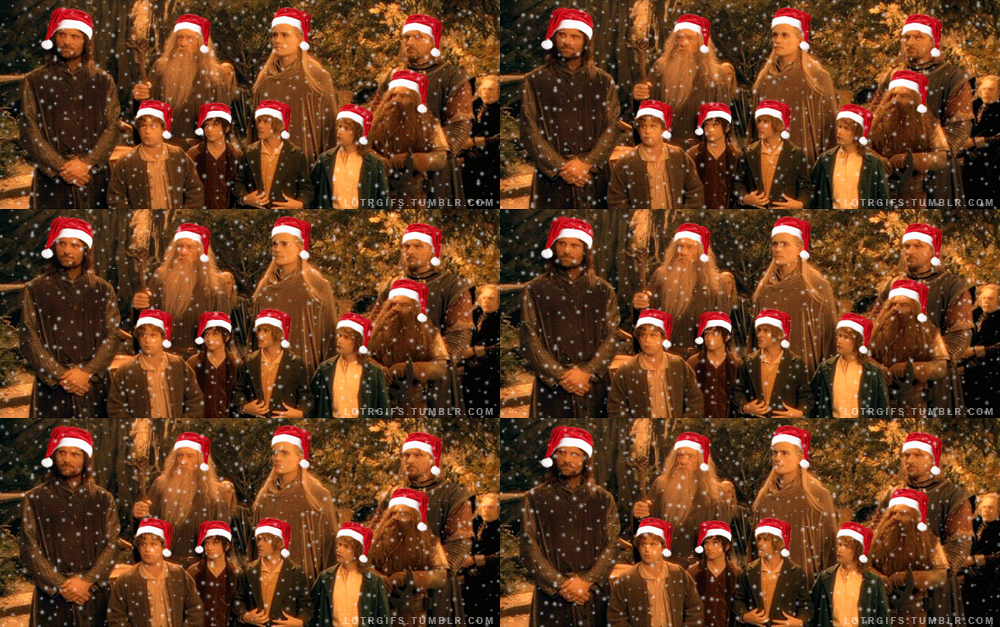 Christmas came early today with the release of the first teaser for "The Hobbit". I am overjoyed. It's been like seven hours and countless reviewings since the trailer was released and I'm still overjoyed, that's how brilliant it is. I've been waiting for this since I was five years old and all that waiting was worth it. I couldn't be happier, really. And I can't help but wonder what the actual trailer will look like if this is only a teaser! The trailer for "The Dark Knight Rises" that was released a few days ago was really good, and I also love the "Hunger Games" trailer, but nothing. Nothing comes close to this. Nothiiiiiiiing.
