As I promised those of you who know me not only on blogger but also on facebook, in honor of Guy Fawkes Day I've decided to post here the essay I wrote about him last semester for history class. I had to give a big presentation as well as write the speech, and the paper was an accompaniment to the presentation, so I do not go into as much detail as I could have regarding the intricacies of the plot, the fate of the conspirators, subsequent history, etc. Instead, I focused on one theme, namely, how the story has ben remembered over the centuries. I believe the paper and presentation got an A; I don't much remember the writing of it, as I was too busy panicking and running out of time, hehe. As I do not have the smarts or the memory to recreate my powerpoint presentation below, I have instead taken a lot of the material I used in my presentation, such as weblinks and photographs, and am presenting them again with many of the same points made, but I think with a slightly snarkier attitude. I haven't had much sleep recently, and my inner sarcasm-beast is a bit more alert than usual.
All of the below is copyright to me. Except the poem, which is of course a folk song.
Guy Fawkes: How the Gunpowder Plot is Remembered
‘Remember, remember, the Fifth of November,
Gunpowder, Treason and Plot.
I see no reason why Gunpowder Treason
Should ever be forgot.
Guy Fawkes, Guy Fawkes, t’was his intent
To blow up King and Parli’ment.
Three-score barrels of powder below
To prove old England’s overthrow;
By God’s providence he was catch’d
With a dark lantern and burning match.
Holloa boys, holloa boys, let the bells ring.
Holloa boys, holloa boys, God save the King!’
The British nursery rhyme generally known by the repetitive, sing-song title of ‘Remember, Remember’ has no certain date of origin, although there is evidence that it has existed as a popular song since at least 1850, when The Times reported on people chanting ‘Remember, remember, the 5th of November,/ The Gunpowder Treason and Plot’ in the streets of London (1). Likewise, the author of the poem is unknown, but his purpose in composing ‘Remember, Remember’ is clear: the verse is a reminder of the discovery and thwarting of the Gunpowder Plot, a seventeenth century terrorist plot which, if left undiscovered, would have destroyed Britain’s government. The Plot is curiously little-remembered outside of England, but in England the event is still extremely important, as evidenced by a macabre national holiday known as Guy Fawkes Day, the festivities which take place then, and of course the aforementioned children’s poem. What is ironic, however, is that the Gunpowder Plot and Guy Fawkes himself are remembered erroneously in modern Britain. This scrap of simple rhyme which is taught to first year students throughout the country represents a purposefully faulty national memory which calls into question the very nature of remembering, and thereby the nature of history itself.
The roots of what would become the Gunpowder Plot first sprouted in 1603, from the mind of a young British nobleman named not Guy Fawkes, but Robert Catesby. Catesby was a Catholic, as were all the men who were eventually to join him in conspiracy, Fawkes being one of these. The sixteenth century was a time of religious turmoil and strife in Britain, first with the persecution of Protestants during the reign of Mary Tudor, then followed by the reciprocal persecution of Catholics during the reign of Mary’s Protestant sister Elizabeth. Catesby, along with many other Catholics, suffered under the rule of Elizabeth and, in turn, that of her successor, the Scottish King James VI. By the turn of the century and the coronation of the new Protestant king, the radical and hotheaded Catesby decided that he must turn to terrorism and assassination in order to gain a new and free future for his religious faith. The complex and fraught religious backdrop to the plot used to be recognized in ‘Remember, Remember’ with additional (Protestant) lines mocking the Pope and the Catholic religion, but these have been removed over the years as religious tolerance became more prevalent in British society. This is unquestionably a good change, but it has also had a curious effect: children grow up in Britain knowing that Guy Fawkes tried to blow up Parliament on November 5, 1605, but they are ignorant as to his motives and to the religious strife which was so crucial to the whole event. The poem clearly declares Fawkes’ ‘intent’ to destroy the King and Parliament, but carefully avoids discussing what fueled that intent, in what seems a ‘cover-up’ of ugly but important historical fact.
Catesby’s initial plan was to dig a tunnel which would lead under the Houses of Parliament. From there he would set off a massive amount of gunpowder, wiping out not only the King but also his wife, his sons, and his Parliament. King James’ young daughter Elizabeth would then be set on the throne as a puppet-ruler, trained and controlled by Catholics, to return government power back to the Catholic faith. Catesby was evidently eloquent and likeable; he is described as possessing ‘the knowledge of character, the tact, eloquence and shrewdness combined with will, daring and force, that enabled him to rule unchallenged the men of tempestuous character he gathered around him’ (2). He therefore quickly won other frustrated young Catholics to his cause, most notably two men named Thomas Percy and Thomas Winter. Of the thirteen known conspirators, these three were the most influential and important, for they were the masterminds of the Plot. Guy Fawkes was the fourth man recruited, but his job was not to plan, being instead to carry out orders given to him by superiors such as Catesby. When the tunnel idea failed due to the unexpected difficulty of the labor involved, the conspirators decided to work from a house near to Parliament instead. Guy Fawkes was stationed at this house in the guise of a servant, as a guard to watch over the gunpowder, and with the additional responsibility of being the man to set off the powder on November the fifth. Thus his journey to infamy began.
Considering his somewhat lowly role in the development of the Gunpowder Plot, as more of a loyal follower than a leader, it is peculiar that Guy Fawkes is the character most popularly connected with the Plot. That this is so is evidenced by the national holiday bearing his name and the fact that his is the only name mentioned in the ‘Remember, Remember’ nursery rhyme. Every British schoolchild could tell you that Guy Fawkes was the man who tried to blow up Parliament, but practically no one knows the name of Catesby or Winter, the men who persuaded Fawkes to blow up Parliament. The character of Guy Fawkes has transformed over the years into that of a tragic hero or romantic villain, who is apprehended by the King’s men mere moments before he sets fire to the gunpowder, with a ‘burning match’ already in his fingers. This is not the true account of what happened: the truth is that Guy Fawkes was seen in the cellar but not arrested, and that it was only later that night when he emerged from the cellar suspiciously dressed for travel that he was captured. His clothes, and not the match of the rhyme, gave him away. There was no lighted match involved, and no gunpowder close enough to Fawkes to be dangerous at the time of his arrest. The image of Fawkes surprised in the cellar, however, remains one of the most powerful images of the Gunpowder Plot, no matter if it is fabricated, and is yet another popular misconception promoted by the nursery rhyme.
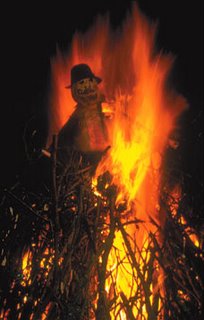
‘Remember, Remember’ is commonly taught today as a children’s rhyme, a piece of propaganda disguised as entertainment instead of a history lesson. When I attended school in Oxford, my first grade teacher taught the classroom the poem for Guy Fawkes Day, and gave us a brief overview of the story of Guy Fawkes: how he was caught just as he was about to blow up Parliament, how he was tortured, and how he was executed. I was six years old when I learned what it meant to be ‘hung, drawn, and quartered’. It was not until many years later, however, that I bothered to learn the truth about the life of the man Guy Fawkes. In the England of today he has become more of an abstract symbol in man’s shape than a historical figure: a lesson warning of the dangers of treason and at the same time an excuse for a party. The sadistic and disturbing custom of burning Fawkes in effigy every November fifth still continues in England, and it is presented as a game to the children, who--and I speak from personal experience--heartily enjoy watching the poor ‘guy’ get consumed by the flames of the bonfire, and chant the rhyme condemning Fawkes without really thinking about what they are saying or doing. On one level, the poem and the festivities it is associated with are celebrations of the British spirit and the ‘providence’ which saved Parliament from being blown up, which explains the fireworks and the teaching the children the triumphant poem; on another it is an attempt at preserving a memory of history and a warning against treason but only a history distorted from the truth; and on another it is a disturbing celebration of the brutal death of one man, a man who has become less of a historical figure and more of a fictional character as the generations pass.
So what does it mean to ‘remember’? In the case of Guy Fawkes, it is to remember only that which your culture wants you to remember. What is important to the rhyme’s British audience is not one-hundred percent historical validity, but instead the message of British pride and confidence the poem can impart to its audience, especially its target audience of children. It is used to teach British children to enjoy watching the image of a man burn for treason. The implications are disturbing, but also profound: Guy Fawkes is chosen to be the scapegoat whose image is burned and whose name is singled out for infamy not because he was more important than his fellow conspirators, many of whom were more to blame for the Plot than he was, but because as the man with the match and the gunpowder he is the conspirator most easily simplified into something easily hated. By focusing solely on Guy Fawkes’ image and intent instead of his motives and his companions, the rhyme can dehumanize the conspiracy and avoid the messy religious context to turn the story into a story to inspire patriotic zeal against the plotters which children’s hearts can understand. By telling the story in a sing-song poem, the historical events are effectively moved from the realm of hard historical fact into that of a story with a lesson. And so the British continue their ‘remembering’, passing the rhythmic poem and its message down from generation to new generation and turning death and torture into a parable and a celebration.
And now with the help of some photographs and articles and the like that I used in slides during my presentation on Fawkes, here's a photographic look at how Fawkes has been remembered throughout the ages, from 1606 to the present day.
For a contemporary view on the matter, I found a .pdf version of the newspaper which was printed the day after Fawkes and his fellow conspirators were executed. The front page article was, naturally, a very detailed account of the whole affair, which was the sensation of its time. Here's what the writer of the article--no doubt speaking for the general opinion of the population--had to say about Fawkes:
"Last of all came the great Devil of all, Guy Fawkes, alias Johnson, who should have put fire to the powder. His body being weak with the torture and sickness he was scarce able to go up the ladder, yet, with much ado, by the help of the hangman, went high enough to break his neck by the fall. He made no speech, but with his crosses and idle ceremonies made his end upon the gallows and the block to the great joy of all beholders that the land was ended of so wicked a villainy."
Fawkes-hatred is quite palpable in these few lines; and there is certainly nothing of the playful festival that is celebrated today in them.
 Fig. 1. That hatred is still apparent in this woodcutting from the seventeen hundreds, but there is also the beginnings of its transformation into a sort of game, showing children triumphantly marching an unflattering effigy of Fawkes about London to celebrate and commemorate his capture and the thwarting of the Plot he was a part of. At this time effigies of the Pope would also commonly be paraded about with Guy, evidence that the memory of religious strife playing a huge part in the Plot was still very much alive.

Fig. 2. Fawkes in the cellar, in his traditional pose of pouring gunpowder while holding a candle aloft, although he never had the time to do anything of the sort. This image is significant, however, because it was an illustration in a book written in the mid-eighteen hundreds which romanticized the story of the Gunpowder Plot and portrayed Fawkes as a sympathetic character, one of the first depictions to do so. The book (which I have read and personally didn't think much of) was immensely popular when it was first published, evidence that the public opinion against Fawkes was no longer quite so vitriolic. I doubt the newspaper reporter of the day of the execution would have found any heroizing of 'the great Devil of all' appealing.
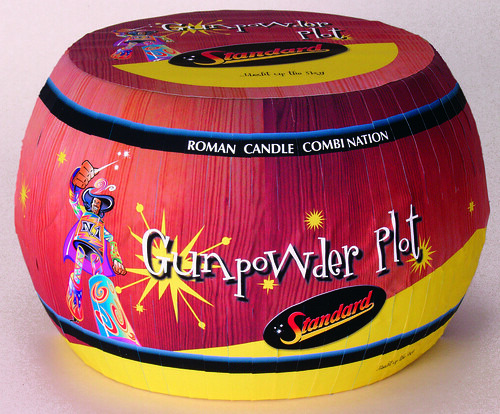
What about today? The effigies known as Guys are still made, only now more emphasis is put upon burning them than parading them up and down streets, and the Pope is generally no longer included in the burning and mocking. Guy Fawkes Day, or Bonfire Day, as it is sometimes called now, is celebrated with fireworks as well as the bonfire, carnivals and parties. It has also been absorbed by our consumerist culture. We have such fabulous items marketing the event as a Guy Fawkes Day Winnie the Pooh dressed up in 16oo's garb and eagerly waving a torch (don't believe me? Click here), a cute barrel-shaped firework designed for the celebrations of the day sporting a cheerful and very colorful Fawkes himself waving a sparkler around (again, click here for the evidence!). If I were the man, I would not be so eager to torch myself, and would not necessarily agree that the day of my death should be celebrated with huge festivals, but whatever.
The best example of how Guy Fawkes is remembered today, however, is evidenced by a page that I found on the Disneyland Paris--yes, DISNEYLAND--website inviting families to bring their kiddies to the magic kingdom for a Guy Fawkes celebration Disney style! Best lines?
"A classic British tradition is ignited with spectacular Disney magic. Musical fountains glisten and jaw-dropping fireworks explode over Lake Disney's giant floating bonfire, all set to an elegant and majestic soundtrack including Disney's Fantasia!"
Just look at that, and then look back at the story of Guy Fawkes. Yeah . . . so many things wrong with this, I don't even know where to begin. I wonder if Pooh bear will be the one given the honor of setting the Guy ablaze?
What I find interesting is a little disclaimer the friendly folks of Disney thought to put on the webpage, which notes that although traditionally the bonfire burning and fireworks exploding and all commemorates the gruesome deaths of Fawkes and his fellow conspirators, 'In modern times . . . the event has had no political significance'. Do you think that's true? And if it is true, do you think it's right? I for one believe you shouldn't exactly celebrate Guy Fawkes Day without realizing exactly what it is that you are commemorating. It's not a pretty story, and any attempts to take Guy Fawkes out of the Day does not, in my opinion, change the meaning of the celebration. Kudos to Disney for trying, though; they just made the whole thing a lot creepier.
And I have to admit that I never before thought that I'd see the words 'hung, drawn, and quartered' on a Disney website. Cheers, Mickey, that made my November.