My littlest sister--she's two--just came over to me where I'm sitting on the floor of my bedroom working on a story. She took my face in her hands and very gently and solemnly turned me to face her. Then, with a very sweet look of concentration on her face, she told me "Here, take the sun--" and very carefully mimed putting something into both of my eyes. And with a satisfied smile, she walked away.
This is part of the reason why I love spending time with my littlest siblings--their imaginations are so strong and boundless and joyous, they can come up with a beautiful idea like placing pieces of the sun into people's eyes. What a powerful notion, and one I know I could never have thought of on my own. Just like the time my four-year-old brother wished me goodnight and then added 'I will go find sweet dreams for you!" I have a little sister who puts the sun into my eyes, and a little brother who spends his dreamtime collecting sweet child-dreams to give to me, since I am now too old, alas, to find any of my own. I am so very fortunate to be their older sister.
Showing posts with label Being thoughtful. Show all posts
Showing posts with label Being thoughtful. Show all posts
Monday, August 16, 2010

Tuesday, July 20, 2010
Toy Story 3: What Starts as a Review Ends as a Meditation on Why I Cried

I finally got to watch "Toy Story 3" today, after months of waiting. Going to the preview screening of the first half of the film was awesome, but of course it meant I was stuck on a cliffhanger for a looong time, haha. I read a few reviews before going, but deliberately stayed away from spoilers; I prefer to see movies without knowing that much about them beforehand, which is also why I'm staying away from "Inception" reviews right now. I couldn't help but gather, however, that TS3 made numerous people cry. I thought this a good sign, but of course people have cried in past Pixar films too--my younger brother still tears up whenever he watches "Up", and Jessie's song in "Toy Story 2" is heartbreaking every. single. time. I expected "Toy Story 3", therefore, to continue Pixar's tradition of creating thought-provoking, heart-touching, funny and sweet and complex and beautifully multi-layered films (with the exception of "Cars". Sorry, I just don't connect with that one).
So did it? Well, in my opinion--yes, absolutely. It was funny, scary, excellently plotted and paced, gorgeously animated, and forms a very fitting and natural end to the Toy Story saga. I remember watching the first "Toy Story" when I was four years old very clearly, because it was the first time I really lost myself in a film. I had favorite movies before then, and I had loved films before then too, of course. But while watching TS in the movie theatre, I quite literally lost myself in it. It was only when my friend's mom nudged my shoulder to offer me popcorn towards the end of the movie that I came to my senses with a jerk, suddenly aware of being in a large, dark room, surrounded by strangers. I was disoriented, dizzy, and confused. I had forgotten where I was, being so swept up into the story on the screen that I had temporarily entirely left my own.
That experience hasn't ever happened to me again. Sure, there are movies I absolutely adore and have been swept up into--the Lord of the Rings trilogy comes to mind, as do many others: "Star Trek", "Ratatouille", "Pan's Labyrinth", "The Princess Bride", "Lawrence of Arabia", and most recently "How to Train Your Dragon"--but I always, at least at the very tip of my subconscious, am aware that I am watching something on a screen, am aware of my surroundings, am aware of my own body and self independent from the story I'm watching. That kind of pure absorption only happens to me now when I read a really good book. Perhaps a magical experience like that cannot happen more than once. Perhaps I've grown up too much.
"Toy Story 3" did not make me forget where I was while watching it. I laughed, and listened for the sounds of other people laughing with me. I glanced at my siblings sitting next to me to gauge their reactions to certain spots. I readjusted and readjusted my 3D glasses (Yes, I did see it in 3D, but it was on discount and definitely worth it). TS3 didn't work the magic of making me lose myself utterly in film. What it did work was the magic of making me cry.
Don't get me wrong, I'm not a hardened sort of film-watcher. It's actually painfully easy to get me emotional. I've teared up while watching many, many films. The beginning of "Up" made my eyes swim. I still get a painful lump in my throat when I watch Frodo farewell Sam at the Grey Havens. "Ice Age" has a few scenes that almost bring me to tears. It is, however, difficult to get me to actually weep. I could probably count the times that's happened on one hand. But it's time to add "Toy Story 3" to that select list, because it didn't just make me drop a tear or two. I had tears streaming down my face, dripping from my chin. I had to clench my jaw to keep from sobbing aloud. I wept even as the credits began rolling, and when I did manage to finally compose myself, I tried to talk about the movie with my mom on the drive home and started crying again.
I was stabbed in an emotional solar plexus I didn't even realize previously that I had.
St. Augustine, in his "City of God" and "Confessions", condemns plays and fictions as sinful, because they can compel us to feel emotions for things that are not real, thereby (according to him) hardening our emotions against distressing realities. St. Augustine was a great theologian and a great man, but I think he's not quite right on this one. It's true that film can, in some ways, desensitize us, but it can also strike our hearts in ways that make us better people. During the scene that caused me to cry in "Toy Story 3", I was overwhelmed because I sympathized with Woody and acutely felt what his character was going through, but in addition to that, I sympathized with Andy, just as fully as I did the toy protagonist. That in itself doesn't really disprove Augustine's argument about fiction damaging the viewer. What does, however, is that the grief I felt wasn't really just about pictures on a screen; it was about myself. When Andy's brilliantly animated face subtly flickers through a myriad of expressions, I knew what he was feeling, and knew it like a knife, because I have felt it too. I didn't ache for Woody just because he was a character I liked; it was because I've had to struggle with goodbyes and uncertainties as well. What Pixar manages to do in this film is not merely get me to sympathize with the characters, but actually through them sympathize with myself. That may look like Andy and Woody up on the screen, but it's also me. I see hard choices and issues and fears that I've had to tackle in my own life, the things one usually just grits one's teeth about and plunges through somehow without letting emotion get in the way--and it's like living those moments again, but now I can shed a tear or two not only for the hurt but also in relief because I know I've made it through difficult times and I can see that reflected in the story unfolding before me, too. Okay, so perhaps Augustine would still think I am a nutcase. But as Gandalf so wisely says, 'Not all tears are an evil.' I cried, sure, but I'm not embarrassed about it. It was something of a healing experience, as silly as that sounds. The last act of the film was one of the most perfect moments of cinema I have ever watched. One of the most painful parts of growing up is struggling to say goodbye to a childhood that slips away so gradually you tend to lose it before even realizing it's gone. "Toy Story 3"'s final moments basically serve as a beautiful distillation of childhood, mine, yours, and everyone's; childhood in a concrete form that you can really say goodbye to and finally get some real closure for.
So I guess I did kind of become absorbed in the film after all, but not to the point of losing myself, as I did all those years ago when I was a five-year-old kid on a playdate with a friend. This time, I lost myself in the film deep enough to find myself in it. And that's a special kind of magic all of its own.
Monday, April 19, 2010
Ugh
I'm having a bit of a bad day. I'm getting all sorts of conflicting information on how to take a year's leave of absence from school, but need to make my decision soon, and the stress and magnitude of the decision and all the unexpected problems with what should be a simple process that keep cropping up is leaving me a bit rattled and emotional and run-down. It's just compounding a lot of issues at once, and I'm finding it all a bit too much to handle. I just checked my phone's clock to find out I've been sitting on a bench at school crying for two hours straight. It makes me feel daft, which just makes me a bit more miserable. Oh well. I was happy this morning, so I know I'll pull myself together and cheer up. The wind rustling and roaring in the dead palm fronds above my head is noisy in a comfortable susurrus sort of way, and I like the feel of the cool air and the warm stone bench I'm perched on. I also finished "Snow-Walker" today at last, and am eager to begin reading "The Robots of Dawn", although that will have to wait until I'm back at the apartment because I left it in my room. Also, I walked out of my Nutrition exam this morning feeling a lot better than I had when I walked in, which is a good thing.
So I'll gather my scattered nerves and thoughts and emotions together and carefully put them all back into their labeled compartments and drawers and then lock up and go out to get something to eat and something to read. That should help immensely.
So I'll gather my scattered nerves and thoughts and emotions together and carefully put them all back into their labeled compartments and drawers and then lock up and go out to get something to eat and something to read. That should help immensely.
Thursday, December 31, 2009
Farewell to 2009
It's even harder, in a way, to farewell 2009 than it was to farewell 2008 a year ago. Perhaps this is because 2009 ends in a 9, (which has always been one of my favorite numbers) and therefore is an odd number. I have always liked odd numbers better than even numbers. My mother says that's because I'm odd myself, which might very well be true, but whatever.
It might also be, however, because 2009 was such a very full, very exciting year. It's strange that although things happen and change, I never really feel like so very much is going on in my life, until I stop and reflect a moment like I do at the end of each year and realize, wow, I have had a full year! In January I watched "Inkheart" after a wait of many years and finished my first knitting project; in February I discovered the beauties of William Morris's writing; I turned eighteen in March; April was the Spam Jam at Waikiki, a rather unique experience; May marked my excruciating staph infection; in June I discovered the wonderful world of Bollywood; in July I managed to overcome adversity and actually compete at the Irish Dance National Championships despite my earlier illness, as well as explore beautiful Nashville; August meant the start of my sophomore year of college; in September I went museum-hopping, visiting such places as Queen Emma's Palace and the first Mission in Hawaii; October saw Father Damien be canonized, which was an amazing thing to experience in Hawaii, at the cathedral where he had been ordained; in November I participated in my first ever (but certainly not last!) NaNoWriMo and managed to pound out over 30,000 words, as well as had the opportunity to chop down a section of bamboo forest with a machete; and this December, of course, has been all family, fun, and Christmas cheer.
There's definitely been a mix of both good and bad this year, but that's how it is with all years, isn't it? What's most important is that I feel I got a lot out of it, and have grown as a student, a dancer, an author, and just a person. So yes, I will raise my glass to toast 2009, and although I feel a tinge of sadness as I always do with the ending of anything, I also welcome 2010 and all the adventures it still has in store--both for me, and for you. Happy New Year, everyone!
It might also be, however, because 2009 was such a very full, very exciting year. It's strange that although things happen and change, I never really feel like so very much is going on in my life, until I stop and reflect a moment like I do at the end of each year and realize, wow, I have had a full year! In January I watched "Inkheart" after a wait of many years and finished my first knitting project; in February I discovered the beauties of William Morris's writing; I turned eighteen in March; April was the Spam Jam at Waikiki, a rather unique experience; May marked my excruciating staph infection; in June I discovered the wonderful world of Bollywood; in July I managed to overcome adversity and actually compete at the Irish Dance National Championships despite my earlier illness, as well as explore beautiful Nashville; August meant the start of my sophomore year of college; in September I went museum-hopping, visiting such places as Queen Emma's Palace and the first Mission in Hawaii; October saw Father Damien be canonized, which was an amazing thing to experience in Hawaii, at the cathedral where he had been ordained; in November I participated in my first ever (but certainly not last!) NaNoWriMo and managed to pound out over 30,000 words, as well as had the opportunity to chop down a section of bamboo forest with a machete; and this December, of course, has been all family, fun, and Christmas cheer.
There's definitely been a mix of both good and bad this year, but that's how it is with all years, isn't it? What's most important is that I feel I got a lot out of it, and have grown as a student, a dancer, an author, and just a person. So yes, I will raise my glass to toast 2009, and although I feel a tinge of sadness as I always do with the ending of anything, I also welcome 2010 and all the adventures it still has in store--both for me, and for you. Happy New Year, everyone!
Thursday, December 17, 2009
A Day in My Life, Dec. 17
I originally thought this would be a boring day to talk about. Finals week is winding down, and all I had planned for today was studying and work.
Luckily for you all, however, I am extremely bad at sticking to plans, especially when I'm the one who made 'em. So--here's my second installment of 'A Day in My Life'!
This morning I had to get up at six-thirty to go to the university with my grandmother. Some days this week I've had exams late in the day, and so have been able to sleep in and ride the bus to school, but today my Hawaiian Studies exam was scheduled for 7:30 in the morning. Luckily it was a take-home, group exam, and since my group and I work well together I'm pretty confident we got an A. I was out of there by eight-thirty.
Now, I would have liked to have just gone back to the apartment then, but I couldn't, because I was scheduled to work at my library job from 4-6. So instead, I had almost eight hours to kill. Planning to use that time by studying for my Physics final tomorrow, I walked to the school library and found a nice and quiet alcove to study in. Or, well, to sleep in. I was really tired.
Yeah, I ended up sleeping for a little over an hour, and had really strange dreams. I know that I dreamt that I was watching "The End of Time", and that it was entirely about people asleep in an enormous library, which shows you how exhausted my imagination was!
Erm, once I woke up I realized this was no good, so I left the library and found a bench under an enormous tree. I don't know what type of tree it was, but it's really big and beautiful, with a bright green, feathery canopy that looks like lace with chips of blue sky peering through the openings. I studied there for a few hours, broke for lunch, and then studied some more. My steely resolve to study non-stop did crack at one point and I then spent over half-an-hour playing solitaire on my iPod (Terpsi) while listening to the soundtrack of "Devdas", but all-in-all it was a productive day. I didn't even watch any episodes of "Primeval", can you believe it? Although really it wasn't as hard to avoid as it might have been; the show lost a little bit of its grip on my heart after *spoiler* and *spoiler*. I still love it for the most part, but feel that some elements of the story could have been executed much better.
I also went back to the library to see if they had the actual novel version of "Devdas" (they do) and "The Witch in the Wood" by TH White (they do), and after finding the books and getting all excited about them I left them on the shelves despite the protests of my bookworm heart, because after all I'm heading home on Saturday and don't trust bringing library books with me on a trans-ocean flight. Something to look forward to in the Spring, I guess. I also found a book on the book sale rack that I thought might be interesting. It's called "The Enchanted Cup", I think, and is a retelling of the story of Tristam and Isolde. I didn't buy it though, because I had no money with me. And besides, I don't know if it's any good.
I did find a children's anthology of poetry that Sir Walter de la Mare put together, though! And I read it all, too--it was a nice break from studying and stress. De la Mare is one of my favorite poets, have you ever read his "The Listeners"? If you haven't, you must go read it now. I've got it memorized. Anyway, the poems he chose were fun to read, and he wrote notes to go with them explaining them to his young readers and encouraging children to really engross themselves in the poetry and giving tips on how to enjoy poetry (read each poem aloud slowly; savor each word; envision what the poet is describing and compare it to the reality, if you've seen the reality, etc.). It was really interesting. I particularly liked this line of his that I copied out in my journal right there in the library so that I would remember it:
"Whatever you admire you look at with all yourself in your eyes; and your love for it adds to its beauty."
Isn't that in itself a beautiful saying? He was explaining the merits of poetry, and I certainly agree with him on this. That's why it's possible to read so many poems about the same subject--the sea, for example, or a songbird, or rain--without getting sick of them, because each poet loves the subject in a different way, providing a different lens for the reader to look at the subject with and appreciate the subject through. Does that make sense? I hope it does.
And this quote was just thought-provoking:
"When I was seven I loved rhymes and jingles. When I was fourteen I thought I hated poetry, partly perhaps because I had been made to learn it for a punishment. When I was about fifteen I suddenly realized that when the poet Homer said that his great hero, Achilles, in his rage went out 'black as night' he meant black as night. It was like a flash of summer lightning over a lovely country of hills and forests."
I puzzled over this. What exactly does de la Mare mean, do you think? What is the discovery inherent in the line? I thought perhaps he meant that he suddenly understood the power of the words, that Homer could have said 'black as pitch' or 'black as coal' but instead chose 'black as night' for a purpose. That led me into an interesting musing on the meanings of words and word choices when describing things--do we really think about the words we choose, or do we just write 'black as night' without considering the implications and beauties of the word 'night'--all its airy coldness and sparkling dark--, and not stopping to think if we want to evoke the earthy coarseness of 'coal' or the shining thickness of 'pitch' instead? Perhaps I even got the entirely wrong impression from what de la Mare was saying! I'd love to hear what you think about it.
Anyway, musings aside, I did finally go to work, and did my job (which today was mostly sitting behind a desk and being bored and studying to fight the down-time). Today was only the second time that I've been the one to close up the place, but I enjoy shutting everything down, I've always liked cleaning things and putting things in order and putting things away. It's somewhat meditative. Tomorrow's my last day of work this semester, but I'll be back next semester, thank goodness, because the people I work with are awesome!
After that there's not much to tell. I returned to the apartment about six-thirty in the evening, studied some more, chatted with my family via video Skype (I love Skype!!), and stressed just a teeny bit. I also ate a couple squares of Cadbury Caramello, mmmmm!
Now I'm lying on the floor of my room, which is where I sleep, and am trying to: A) Not think about my exam tomorrow, and B) Not think about all the packing I'm going to have to do tomorrow! I'm such a procrastinator, alas.
It's really hot and humid right now, my ceiling fan's going, and I'm exhausted. I am also excited about finally going home for Christmas.
And . . . yeah, that's my day! I'll try to write up another post tomorrow, but probably will fail because I'm going to be BUSY! Merry Almost-Christmas to you all!
Thursday, November 5, 2009
Remember, Remember, the Fifth of November
As I promised those of you who know me not only on blogger but also on facebook, in honor of Guy Fawkes Day I've decided to post here the essay I wrote about him last semester for history class. I had to give a big presentation as well as write the speech, and the paper was an accompaniment to the presentation, so I do not go into as much detail as I could have regarding the intricacies of the plot, the fate of the conspirators, subsequent history, etc. Instead, I focused on one theme, namely, how the story has ben remembered over the centuries. I believe the paper and presentation got an A; I don't much remember the writing of it, as I was too busy panicking and running out of time, hehe. As I do not have the smarts or the memory to recreate my powerpoint presentation below, I have instead taken a lot of the material I used in my presentation, such as weblinks and photographs, and am presenting them again with many of the same points made, but I think with a slightly snarkier attitude. I haven't had much sleep recently, and my inner sarcasm-beast is a bit more alert than usual.
All of the below is copyright to me. Except the poem, which is of course a folk song.
Guy Fawkes: How the Gunpowder Plot is Remembered
‘Remember, remember, the Fifth of November,
Gunpowder, Treason and Plot.
I see no reason why Gunpowder Treason
Should ever be forgot.
Guy Fawkes, Guy Fawkes, t’was his intent
To blow up King and Parli’ment.
Three-score barrels of powder below
To prove old England’s overthrow;
By God’s providence he was catch’d
With a dark lantern and burning match.
Holloa boys, holloa boys, let the bells ring.
Holloa boys, holloa boys, God save the King!’
The British nursery rhyme generally known by the repetitive, sing-song title of ‘Remember, Remember’ has no certain date of origin, although there is evidence that it has existed as a popular song since at least 1850, when The Times reported on people chanting ‘Remember, remember, the 5th of November,/ The Gunpowder Treason and Plot’ in the streets of London (1). Likewise, the author of the poem is unknown, but his purpose in composing ‘Remember, Remember’ is clear: the verse is a reminder of the discovery and thwarting of the Gunpowder Plot, a seventeenth century terrorist plot which, if left undiscovered, would have destroyed Britain’s government. The Plot is curiously little-remembered outside of England, but in England the event is still extremely important, as evidenced by a macabre national holiday known as Guy Fawkes Day, the festivities which take place then, and of course the aforementioned children’s poem. What is ironic, however, is that the Gunpowder Plot and Guy Fawkes himself are remembered erroneously in modern Britain. This scrap of simple rhyme which is taught to first year students throughout the country represents a purposefully faulty national memory which calls into question the very nature of remembering, and thereby the nature of history itself.
The roots of what would become the Gunpowder Plot first sprouted in 1603, from the mind of a young British nobleman named not Guy Fawkes, but Robert Catesby. Catesby was a Catholic, as were all the men who were eventually to join him in conspiracy, Fawkes being one of these. The sixteenth century was a time of religious turmoil and strife in Britain, first with the persecution of Protestants during the reign of Mary Tudor, then followed by the reciprocal persecution of Catholics during the reign of Mary’s Protestant sister Elizabeth. Catesby, along with many other Catholics, suffered under the rule of Elizabeth and, in turn, that of her successor, the Scottish King James VI. By the turn of the century and the coronation of the new Protestant king, the radical and hotheaded Catesby decided that he must turn to terrorism and assassination in order to gain a new and free future for his religious faith. The complex and fraught religious backdrop to the plot used to be recognized in ‘Remember, Remember’ with additional (Protestant) lines mocking the Pope and the Catholic religion, but these have been removed over the years as religious tolerance became more prevalent in British society. This is unquestionably a good change, but it has also had a curious effect: children grow up in Britain knowing that Guy Fawkes tried to blow up Parliament on November 5, 1605, but they are ignorant as to his motives and to the religious strife which was so crucial to the whole event. The poem clearly declares Fawkes’ ‘intent’ to destroy the King and Parliament, but carefully avoids discussing what fueled that intent, in what seems a ‘cover-up’ of ugly but important historical fact.
Catesby’s initial plan was to dig a tunnel which would lead under the Houses of Parliament. From there he would set off a massive amount of gunpowder, wiping out not only the King but also his wife, his sons, and his Parliament. King James’ young daughter Elizabeth would then be set on the throne as a puppet-ruler, trained and controlled by Catholics, to return government power back to the Catholic faith. Catesby was evidently eloquent and likeable; he is described as possessing ‘the knowledge of character, the tact, eloquence and shrewdness combined with will, daring and force, that enabled him to rule unchallenged the men of tempestuous character he gathered around him’ (2). He therefore quickly won other frustrated young Catholics to his cause, most notably two men named Thomas Percy and Thomas Winter. Of the thirteen known conspirators, these three were the most influential and important, for they were the masterminds of the Plot. Guy Fawkes was the fourth man recruited, but his job was not to plan, being instead to carry out orders given to him by superiors such as Catesby. When the tunnel idea failed due to the unexpected difficulty of the labor involved, the conspirators decided to work from a house near to Parliament instead. Guy Fawkes was stationed at this house in the guise of a servant, as a guard to watch over the gunpowder, and with the additional responsibility of being the man to set off the powder on November the fifth. Thus his journey to infamy began.
Considering his somewhat lowly role in the development of the Gunpowder Plot, as more of a loyal follower than a leader, it is peculiar that Guy Fawkes is the character most popularly connected with the Plot. That this is so is evidenced by the national holiday bearing his name and the fact that his is the only name mentioned in the ‘Remember, Remember’ nursery rhyme. Every British schoolchild could tell you that Guy Fawkes was the man who tried to blow up Parliament, but practically no one knows the name of Catesby or Winter, the men who persuaded Fawkes to blow up Parliament. The character of Guy Fawkes has transformed over the years into that of a tragic hero or romantic villain, who is apprehended by the King’s men mere moments before he sets fire to the gunpowder, with a ‘burning match’ already in his fingers. This is not the true account of what happened: the truth is that Guy Fawkes was seen in the cellar but not arrested, and that it was only later that night when he emerged from the cellar suspiciously dressed for travel that he was captured. His clothes, and not the match of the rhyme, gave him away. There was no lighted match involved, and no gunpowder close enough to Fawkes to be dangerous at the time of his arrest. The image of Fawkes surprised in the cellar, however, remains one of the most powerful images of the Gunpowder Plot, no matter if it is fabricated, and is yet another popular misconception promoted by the nursery rhyme.
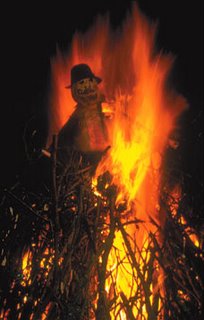
‘Remember, Remember’ is commonly taught today as a children’s rhyme, a piece of propaganda disguised as entertainment instead of a history lesson. When I attended school in Oxford, my first grade teacher taught the classroom the poem for Guy Fawkes Day, and gave us a brief overview of the story of Guy Fawkes: how he was caught just as he was about to blow up Parliament, how he was tortured, and how he was executed. I was six years old when I learned what it meant to be ‘hung, drawn, and quartered’. It was not until many years later, however, that I bothered to learn the truth about the life of the man Guy Fawkes. In the England of today he has become more of an abstract symbol in man’s shape than a historical figure: a lesson warning of the dangers of treason and at the same time an excuse for a party. The sadistic and disturbing custom of burning Fawkes in effigy every November fifth still continues in England, and it is presented as a game to the children, who--and I speak from personal experience--heartily enjoy watching the poor ‘guy’ get consumed by the flames of the bonfire, and chant the rhyme condemning Fawkes without really thinking about what they are saying or doing. On one level, the poem and the festivities it is associated with are celebrations of the British spirit and the ‘providence’ which saved Parliament from being blown up, which explains the fireworks and the teaching the children the triumphant poem; on another it is an attempt at preserving a memory of history and a warning against treason but only a history distorted from the truth; and on another it is a disturbing celebration of the brutal death of one man, a man who has become less of a historical figure and more of a fictional character as the generations pass.
So what does it mean to ‘remember’? In the case of Guy Fawkes, it is to remember only that which your culture wants you to remember. What is important to the rhyme’s British audience is not one-hundred percent historical validity, but instead the message of British pride and confidence the poem can impart to its audience, especially its target audience of children. It is used to teach British children to enjoy watching the image of a man burn for treason. The implications are disturbing, but also profound: Guy Fawkes is chosen to be the scapegoat whose image is burned and whose name is singled out for infamy not because he was more important than his fellow conspirators, many of whom were more to blame for the Plot than he was, but because as the man with the match and the gunpowder he is the conspirator most easily simplified into something easily hated. By focusing solely on Guy Fawkes’ image and intent instead of his motives and his companions, the rhyme can dehumanize the conspiracy and avoid the messy religious context to turn the story into a story to inspire patriotic zeal against the plotters which children’s hearts can understand. By telling the story in a sing-song poem, the historical events are effectively moved from the realm of hard historical fact into that of a story with a lesson. And so the British continue their ‘remembering’, passing the rhythmic poem and its message down from generation to new generation and turning death and torture into a parable and a celebration.
And now with the help of some photographs and articles and the like that I used in slides during my presentation on Fawkes, here's a photographic look at how Fawkes has been remembered throughout the ages, from 1606 to the present day.
For a contemporary view on the matter, I found a .pdf version of the newspaper which was printed the day after Fawkes and his fellow conspirators were executed. The front page article was, naturally, a very detailed account of the whole affair, which was the sensation of its time. Here's what the writer of the article--no doubt speaking for the general opinion of the population--had to say about Fawkes:
"Last of all came the great Devil of all, Guy Fawkes, alias Johnson, who should have put fire to the powder. His body being weak with the torture and sickness he was scarce able to go up the ladder, yet, with much ado, by the help of the hangman, went high enough to break his neck by the fall. He made no speech, but with his crosses and idle ceremonies made his end upon the gallows and the block to the great joy of all beholders that the land was ended of so wicked a villainy."
Fawkes-hatred is quite palpable in these few lines; and there is certainly nothing of the playful festival that is celebrated today in them.
 Fig. 1. That hatred is still apparent in this woodcutting from the seventeen hundreds, but there is also the beginnings of its transformation into a sort of game, showing children triumphantly marching an unflattering effigy of Fawkes about London to celebrate and commemorate his capture and the thwarting of the Plot he was a part of. At this time effigies of the Pope would also commonly be paraded about with Guy, evidence that the memory of religious strife playing a huge part in the Plot was still very much alive.

Fig. 2. Fawkes in the cellar, in his traditional pose of pouring gunpowder while holding a candle aloft, although he never had the time to do anything of the sort. This image is significant, however, because it was an illustration in a book written in the mid-eighteen hundreds which romanticized the story of the Gunpowder Plot and portrayed Fawkes as a sympathetic character, one of the first depictions to do so. The book (which I have read and personally didn't think much of) was immensely popular when it was first published, evidence that the public opinion against Fawkes was no longer quite so vitriolic. I doubt the newspaper reporter of the day of the execution would have found any heroizing of 'the great Devil of all' appealing.
What about today? The effigies known as Guys are still made, only now more emphasis is put upon burning them than parading them up and down streets, and the Pope is generally no longer included in the burning and mocking. Guy Fawkes Day, or Bonfire Day, as it is sometimes called now, is celebrated with fireworks as well as the bonfire, carnivals and parties. It has also been absorbed by our consumerist culture. We have such fabulous items marketing the event as a Guy Fawkes Day Winnie the Pooh dressed up in 16oo's garb and eagerly waving a torch (don't believe me? Click here), a cute barrel-shaped firework designed for the celebrations of the day sporting a cheerful and very colorful Fawkes himself waving a sparkler around (again, click here for the evidence!). If I were the man, I would not be so eager to torch myself, and would not necessarily agree that the day of my death should be celebrated with huge festivals, but whatever.

The best example of how Guy Fawkes is remembered today, however, is evidenced by a page that I found on the Disneyland Paris--yes, DISNEYLAND--website inviting families to bring their kiddies to the magic kingdom for a Guy Fawkes celebration Disney style! Best lines?
"A classic British tradition is ignited with spectacular Disney magic. Musical fountains glisten and jaw-dropping fireworks explode over Lake Disney's giant floating bonfire, all set to an elegant and majestic soundtrack including Disney's Fantasia!"
Just look at that, and then look back at the story of Guy Fawkes. Yeah . . . so many things wrong with this, I don't even know where to begin. I wonder if Pooh bear will be the one given the honor of setting the Guy ablaze?
What I find interesting is a little disclaimer the friendly folks of Disney thought to put on the webpage, which notes that although traditionally the bonfire burning and fireworks exploding and all commemorates the gruesome deaths of Fawkes and his fellow conspirators, 'In modern times . . . the event has had no political significance'. Do you think that's true? And if it is true, do you think it's right? I for one believe you shouldn't exactly celebrate Guy Fawkes Day without realizing exactly what it is that you are commemorating. It's not a pretty story, and any attempts to take Guy Fawkes out of the Day does not, in my opinion, change the meaning of the celebration. Kudos to Disney for trying, though; they just made the whole thing a lot creepier.
And I have to admit that I never before thought that I'd see the words 'hung, drawn, and quartered' on a Disney website. Cheers, Mickey, that made my November.
Friday, October 30, 2009
"Sword at Sunset", by Rosemary Sutcliff
I'll save the full review for my October Book Reviews post, which is due shortly anyway. But this book filled me with so much joy, I need to post some of my favorite quotes right now. It's a retelling of the story of King Arthur, but an attempt at making his story one of plausible historical fiction--no Round Table, etc. But still retaining elements of the legend. Instead of Lancelot and the Knights of the Round Table serving King Arthur and Queen Guinevere at Camelot, we get Bedwyr and the Brotherhood of the Romano-British war chieftain Artos, who is married to a woman named Guenhumara and spends his life fighting against the Saxons. And I really, really enjoyed it. The soul of the stories are still here, bright and beautiful and written with both realism and poetry. I enjoyed it so much, I put it aside yesterday when I had about fifty pages left so I could savor the reading of it a day more. This is a novel highly recommended.
And here's one more quote as a bonus, this time from the lips of Mordred--for there is a Mordred in even this version of the Arthurian story, though called Merdraut. Again, his link with his mother is stressed. This seems to be a sign by which one can tell when Mordred is really being written well: That the relationship between Mordred and Morgause is not merely that of a son whose mother has taught him to hate, but that of a man who was warped and ruined somehow by his mother's very love. It's a terrifying concept, but also one that can, in the right hands, invoke immense pity. I'm thinking the part in 'The Once and Future King', here, where Mordred is described as having been somehow drained of himself by his mother, as though she sucked him dry like a brooding spider, so that he lives as not only an embodiment of his own hate, whether he will or no, but also as a projection of hers. Check out the similarities with that idea here:
This is one of the moments that stood out most for me. The book is told from the perspective of Arthur himself, and this scene is where he goes hunting with the High King Ambrosius, shortly before gaining the Kingship himself. Ambrosius is dying of disease, and on this particular day is determined to go hunting, which is treated as a metaphor in the story that he is going knowingly to his death, hunting his death. Anyway, this part really stood out to me, both in terms of beauty and due to its fascinating and poignant musings on how one prepares for death:
'The sun came up, and the frost melted around us as we rode, giving place to a thin white mist lying close to the ground in the hollows. The horses waded through it as through shallow seas of gossamer as we dropped into the valley, and small bright drops trembled in the light, hanging from every dried hemlock head and half-silken, half-sodden feather of last year's willow herb. And I remember that over the open fallow the larks were singing. In a sheltered hollow of the woodshore, the first hazel catkins were hanging out, and as we brushed through, shaking the whippy sprays, the air was suddenly stained with a sun-mist of yellow pollen for yards around. And I wondered how it all seemed to Ambrosius: whether he had yet freed himself utterly from the dearness and strangeness and piercing beauty of the world, from the lark song and the smell of melting frost on the cold moss under the trees, and the thrust of a horse's flanks beneath him, and the faces of his friends. His own face betrayed nothing, but I thought that he looked about him from time to time, as though he wished to see very clearly the winter woods dappled like a curlew's breast, the prick of a hound's ears, the crimson thread tips of a woman-bud on a hazel spray, the flying shadow of a bird across the turf, to draw them in and make them part of himself, part of his own soul, so that he might carry them with him where he was going.'
And here's one more quote as a bonus, this time from the lips of Mordred--for there is a Mordred in even this version of the Arthurian story, though called Merdraut. Again, his link with his mother is stressed. This seems to be a sign by which one can tell when Mordred is really being written well: That the relationship between Mordred and Morgause is not merely that of a son whose mother has taught him to hate, but that of a man who was warped and ruined somehow by his mother's very love. It's a terrifying concept, but also one that can, in the right hands, invoke immense pity. I'm thinking the part in 'The Once and Future King', here, where Mordred is described as having been somehow drained of himself by his mother, as though she sucked him dry like a brooding spider, so that he lives as not only an embodiment of his own hate, whether he will or no, but also as a projection of hers. Check out the similarities with that idea here:
'[Merdraut] came toward me, and before I knew what he was about, knelt beside me and bowed his head onto my knee. It was a horrible womanish gesture. "No escape . . . It is in what you are and in what I am." His voice muffled against my knee. "No, don't draw away from me. Whatever else I am, I am your son--your most wretched son. If you do not hate me, try to love me a little, Father; it is lonely never to have been loved, only devoured.'
The same images of devouring and helpless hate are here. And the characterization is similarly brilliant. It's an interesting parallel to ponder. And masterfully written in its own right.
Sunday, September 27, 2009
Exploring Island History
Hello, all you lovely people, and I hope you are having yourselves a fine weekend.
I pulled my first all-night study session of the semester on Thursday night--mainly due to the "Beowulf" essay that simply did not want to be written. I re-wrote the horrid thing upwards of a dozen times, and I still am not happy with how it turned out. Of course, I'm never happy with anything I write,
but I really wasn't happy with it. Well, anyway. Speaking of Anglo-Saxon gorgeousness, I hope you all were as ecstatic as me when you heard about the immense new find of Anglo-Saxon treasure in England--three times the size of Sutton Hoo's hoard, or so I have read. Unbelievable. There is an incredible magic in old artifacts like that, something that tugs at my heartstrings in a way nothing else quite does. To understand what I mean, read A String in the Harp.
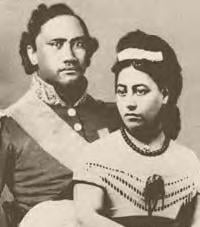
Today I should have spent my time recuperating from the horridness of being awake for twenty-two hours straight, but instead I went to visit a few local museums: the Mission House downtown, which is the original Mission that was built here in Hawaii in 1820, and Queen Emma's palace. (That's Emma and her husband, King Kamehameha IV in the above photograph.) The Mission House was adorable, and it was really strange and sad to see it in old photographs showing it surrounded with miles of green jungle, when now it sits serene and somewhat forgotten in the middle of downtown Honolulu, dwarfed by roadways and skyscrapers. The house was very small, very quaint, and as the guide pointed out, 'It was built by New Englanders, and they built it in the style of a building they would have lived in back home--that is, they built it to keep out a New England winter. They discovered their mistake later.' He was quite right; the place was stiflingly hot. There's a certain special way to build a house in Hawaii; build it in the right direction, and put large windows and doors in the right places, and make the ceilings high, so that the trade winds flow through the place like cooling water. The missionaries did none of this, and even though they've been dead for over a hundred years, I still felt sorry for them, poor chaps.
Apparently they serve high tea at a little set of tables on the grass next to the house, under some spreading green trees. I hope to partake, one day. Oh, and we got to see the Mission printing press, which excited me a lot. I love printing presses. though for some reason I can't see one without thinking of Rab Silsbee from Johnny Tremain. Then again, perhaps that's one of the reasons why I like printing presses . . .
My grandma and I were going to take the bus to Queen Emma's palace, but some of our fellow Mission tour guide-takers were going to the palace also and offered us a ride. They were really nice, a mother and daughter. We toured the palace with them too, and all four of us became relatively chummy by the end of the day. The palace was lovely; it looked like a Southern mansion, all white with enormous windows and enormous rooms. In one room was the Queen's grand piano, which she purchased while in Germany, and apparently she was a very gifted pianist. What is awesome is that you are allowed to play the Queen's piano, as well as take pictures while you do so! I've often wished that I could play piano, but never more than today . . . that didn't prevent me from posing with my hands on the keys though, ha. There were many portraits of royal family members, including a couple beautiful portraits of her son, the Crown Prince, who died when only four years old. He was an adorable child, and always looks so solemn but sweet in his portraits . . .
For those of you who don't know much about Hawaiian monarchy, I strongly recommend you research and learn about it. It was a monarchy recognized and respected all around the world at one point: Emma was given wedding gifts from places as far off as India and China, and Queen Victoria of England was Emma's son's godmother. The story of the monarchy is one of the most interesting, sad, and, yes, controversial in all of history. There are some people out here who regularly storm I'olani palace and lock themselves in to protest the fact that Hawaii was annexed to the US, and there are some who are fiercely devoted to its identity as a US state, so it's a big issue here. I personally don't like to get embroiled in the issue, but I do like learning about it. And the Hawaiian monarchy was a far more legitimate, advanced, and efficient government than most non-Islanders know, with really fascinating members (Queen Emma and Princess Kai'ulani being among my favorites. Kai'ulani was the last princess of the Hawaiians, good friends with Robert Louis Stevenson, an excellent painter, and died extremely young). Ignorance is sad, so learn!
On a lighter note, I have begun (after much urging from friends) to watch 'Firefly', and must say that I'm enjoying it so far. I found the second episode much better than the first, though; the first was okay, but the dialogue wasn't as sparkly as I would have liked. Still, it seems to be a fun show. Mixing western with the space age was a genius move, and I'm sad the show has so few episodes; it seems to be only getting better, so why cut it off?
Anyways, that's all for now, folks! Oh, and I'm beginning to type up all my book reviews for the month (there's quite a few, actually!) so you can start looking forward to them now ;)
Friday, May 29, 2009
Half-awake Nonsense
I should not be awake yet. Not judging by the amount of sleep I snatched last night. But now that I am awake, I dare not go to sleep again, for fear of missing when I need to take my medicine. Bah.
I fill the dull intervals with blogging. And, hopefully, writing on more creative topics as well. My two Faerytales are still coming along, and I really do want to get my novel more organized and further along this summer. I had wanted to do some art too, but I do not know now if I shall . . . I find there are so many things I want to do, I scarcely know where to begin! I have promised my youngest brother a batch of cookies, so I'll have to do that sometime. I found a recipe for white chocolate macadamia nut pineapple cookies online, that sounds interesting and tasty, doesn't it?
Right now I am lying curled up on my top bunk of the bed I share with two of my sisters, and I have a pillow under my feet for no real reason that I can think of. It is strange, after sleeping on an air mattress at my grandmother's apartment all semester, to sleep so close to the ceiling. Some childish part of me is absurdly pleased with the fact and enjoys stretching up a hand to touch the ceiling just because it can; the more mature, grown-up part curses inwardly every time I wake up in the morning, forget the ceiling is right there, and crack my head against it. I could extend this into a philosophical ramble, but I am too sleepy to seriously contemplate it long enough, so I just leave the issue to your very capable pondering. I only wish to add that it certainly illustrates the fact that there are two very different ways to look at everything.
As to my illness, as some of you already know, it now looks as though surgery will not be needed, but that extensive antibiotic treatment will continue for some time. Still, most of the swelling and essentially all of the pain is gone now, which is an immense relief. Thank you, Lord. It looks like the Irish Dance National Championships are on the table again, although considering that due to exams and ill health I have not dance in about three weeks, I am not as optimistic about my chances of placing as I could be. However, I shall devote myself to working hard all summer until competition, and will just be grateful for the health that allows me to dance at all.
I have two hats and a set of fairy wings hanging from my bedpost, as well as a large collection of medals. The hats fit me; the wings do not. I bought the wings for my sister back in the days when she wanted to be a fairy princess. Now, I believe, she wants to be a teacher. She's eight years old and starting to grow up.
On a completely unrelated note, I believe the ending of Devdas is among the best endings of any film ever.
On another completely unrelated note, I'm thinking of trying to cook some soup today, if my back will be able to handle me standing and walking to and fro in the kitchen for a couple hours.
. . . Sorry, I'm just getting randomer and randomer.
See, this is why I shouldn't post as soon as I wake up in the morning. My head is still too full of dreams for coherence. I'll try to post something sensical later to make up for this, okay?
Wednesday, May 6, 2009
Finite (Almost)
School officially ended today. After a limbo of final exams next week, I'm free! Home is just around the corner!
http://americanchestertonsociety.blogspot.com/2007/10/dr-thursdays-thursday-post.html
And I found this very interesting, entertaining, and well-written.
Now, if you'll excuse me, I have to go blow my nose and cut up more lemons . . .
Wednesday, April 29, 2009
A Pause Between
Finally, my first poem in months! Composed during the middle of writing a story (yes, Laura, the next part of 'Sons of Cwendor' should be up soon). Comments are of course always appreciated and replied to . . .
A Pause Between
Whence come these words?
From what whispering tongue?
Or what grey spider shining spun
These filaments, the ghosts of sound,
The snares by which my thoughts are bound
And pinned upon the bleach-boned sheet,
Their airy beauty made concrete?
I know not how they come to me--
Like leaves snatched from a gilded tree,
Or gemstones delved from hallowed grounds,
The bright sea where my reason drowns.
Is it I who seek, or they who find,
These words which whisper in my mind?
I do not understand this mystery--
How do these words belong to me?
Monday, April 13, 2009
Men are Stupid
This semester all my professors are male. I don't mind this; they are all knowledgeable in their fields, hard but fair graders, easy to get along with, and, frankly, I couldn't care less the gender of my teacher as long as they teach well. But I have noticed something which strikes me as strange. Each professor (at least once; one practically every class) has told us students in one way or the other, in one context or another:
"Oh, yes, and men are stupid."
Which gets an appreciative giggle from the class, male and female students alike, and then the lecture continues.
I find this oddly irritating.
I am not by any means against the empowerment of women; it is true that women have traditionally been given poorer education than men, something which I, as a bookworm and knowledge-hungry nerd, see as nothing but deplorable. But to me, empowerment is equal opportunity, not using obsession over equality as an excuse at belittling others, not only of the opposite gender, but of your own. I find this sort of extreme feminist sort of talk aggravating enough when a woman is doing it; why do men now seem to be jumping on the bandwagon in bashing their own sex? I mean, good for all those females who are now seeking careers in science and math and all--they have a right to it-- but does this necessarily mean, in the words of one of my professors, that they are 'triumphantly breaking free of the chains of tradition and taking over the scholarly world, which is only fair because women are smarter than men. Sorry guys, but we're idiots.'
I think not. Men are people too. Men have the same rights as those women clamor for. Why can't we just accept that both women and men can be intelligent and successful and worthy of each other?
Perhaps I'm just living in the past, but I don't think that by glorifying women and knocking down men we can create a more perfect world.
And so, sitting in my classes--most particularly the one where I get subjected to jokes about male inferiority every week--I find myself pondering, not the lesson on the board, but instead other questions whispering in my mind.
Why, in our modern educational culture, do we think it fine to class men as 'stupid' in an attempt at pumping women's egos higher?
Why, in our efforts to 'break down barriers', do we think the proper procedure is to swap which side of the wall we stand on and then build the barrier stronger?
Why do we pursue equality not simply by giving those who are lower a hand up, but instead by dragging down those who have been higher and then trampling on them?
Monday, March 9, 2009
Ah, the Subtleties of Modern Art
So I was climbing up to the third floor of one of my school's libraries, to retrieve the "Pan's Labyrinth" DVD that I put on hold this morning (yes, I do actually have it in my possession now), and I was going casually because I enjoy walking up and down stairs without my ginormous backpack dragging me down.
I noticed that there are pieces of art set at intervals along the way: paintings on walls, and statues on the landings. Even a replica of the Rosetta Stone is set in the wall at one point (and speaking as one who has seen the real thing I have to say it is nowhere near as beautiful as the original). You know what I mean: the sort of modernist sculptures of metal and stone twisted into weird shapes that make one long for the marbles of Ancient Greece; the fuzzy, colorful paintings that can be made out when squinting and standing on one's head. They give a general air of grandeur and 'class', but on scrutiny I generally find them to be lacking any feel of what I deem as art.
Anyway, I was scrutinizing them anyway, because it was pleasant to be climbing stairs without needing to go to class, and I hoped to find at least one piece of art to really enjoy, and upon the second floor landing there was a sculpture which really caught my attention. It was, to all appearances, a vaguely rounded lump of stone, perhaps knee-high and between one and two feet in width, set upon a pedestal, and colored a greyish, reddish-brown.
What is this? I wondered. And so, since I had time to spare, I walked over and stooped to read the plaque set at the pedestal's foot. And there I read the sculpture's name:
The Rock.
. . . It is comforting, is it not, to know that the modernist art movement is coming full circle? They now use enormous lumps of stone to make models of rocks. And then display them as wonders.
Speaking as one who has seen the real thing, I have to say that this sculpture is nowhere near as beautiful as the original.
Friday, January 16, 2009
Four Day Weekend, lalala

Due to 60 mph winds, torrential rain, and other nasty weather today, school was cancelled. Which means I now am smack in the middle of a four day weekend. What a glorious place to be.
Of course, my teachers will probably retaliate with crushing loads of homework next week. As any fairytale reader knows, all joys must be paid for. Still, I don't mind right now. I'm relishing the tropical rain-smell coming through my window slats, and am writing. As usual.
My imagination is like a maze, or an onion. I bury myself so deeply inside it that I have to peel away layers in order to find myself again, and oftentimes I have so much fun that I really don't want to come back out. But necessity always dictates that I do. I'll be in a character's head . . . and then I have to retreat to watching the character from the outside . . . then retreat until I'm looking at the scene from the outside . . . and then I have to step outside of the fictional world I was exploring . . . and then I find I'm in Hawaii, surrounded by misty green mountains where the rainfall makes a hundred waterfalls. My grandmother says that when a really big storm comes and the air is clear enough you can see all the waterfalls and it looks as though the mountains are crying. I walked around in a happy poetical daze for hours after hearing that!
So--after a long and involved time storycrafting I emerge from the Fairyland inside my head to this place, where the brooding sky is like silver, and the mountains weep. Fantasy and magic and stories of elves and enchanted places aren't escapist at all. Because if you look at the world you live in correctly--well, sometimes you can't even tell the difference.
Monday, December 29, 2008
Made Me Cry (Almost)
Everything that I have tried to say in my poetry, is captured in these few lines. When I read them, I felt my heart shiver. It will haunt my dreams, tonight.
by Shel Silverstein
Once I spoke the language of the flowers,
Once I understood each word the caterpillar said,
Once I smiled in secret at the gossip of the starlings,
And shared a conversation with the housefly
in my bed.
Once I heard and answered all the questions
of the crickets,
And joined the crying of each falling dying
flake of snow,
Once I spoke the language of the flowers . . .
How did it go?
How did it go?
Monday, December 1, 2008
Homesickness, and Thanksgiving
So I just visited Laura's blog, and very fortunately for me she had posted a series of lovely, calming, peaceful and reflective posts. I was having a bit of a rough day today. Namely, I received my first photograph from home today, and it was of my youngest baby sister laughing at the flickering candles on her first birthday cake, and it left me depressed all day. Isn't that strange? I should be ecstatic just because I got to see her beautiful face again, but . . . well, it's changed. Like I knew it would, but still. And in all that joy and sweetness in her smile, in her laugh, in her eyes . . . there wasn't any for me. I'm not in her life right now, and no matter how I play with her and communicate with her on holidays and as time grows by and she grows up and realizes that her elder sister is living away from home, I can't change that. The bitter fact that she has lived these past few months and grown and changed and now has a laugh and the tentative beginnings of a voice and a feisty personality and a recognition of and love for her family. And that I am not a part of any of that. She celebrated her birthday, lived these past few months of her life without missing me, and she never will. Oh, that might seem so silly to people who don't have little siblings and love little siblings like I do! But trust me, it's hard, hard, hard.
. . . Enough of that. I was crying at my computer screen earlier, and it does sound very comical, but isn't so funny in practice. But Laura, your post helped me a lot. I do have a lot to be thankful for. Life is beautiful no matter where you are. I'm fortunate in my family, that even though I'm not with them I can still write to them and speak on the phone to them and I'm going home in 19 days!
Thanks, Linden. Thank you very much. (And I have your Christmas gift wrapped and ready, but part of it might be a little late. We'll see.)
Well, now that I've been able to vent a little and get all my accumulated 'feeling-sorry-for-myself' out of the way, it's time to share a little about my four-day weekend.
Thursday: Thanksgiving, of course. And what better way to kick off Thanksgiving than to watch 'The Fellowship of the Ring'? Which of course I did. And I went to Thanksgiving dinner with my grandmother and a few of her friends, and the food was quite good, but I stuck out like a sore thumb because I wore a dress and everyone else was wearing t-shirts, shorts, and 'rubbah slippahs'. But I didn't mind too much, because I believe that any festive day must be accompanied by nice attire, and so laughed good-naturedly when one of the locals joked that I was so obviously from the mainland "Where they dress up nice the kind, you know?"
By the way, out here people eat sushi for Thanksgiving. I found that interesting.
Friday: I spent some time exploring the island with a friend and his family. Up in the mountains enormous white birds nest, and their voices sound like strange spirits screaming and wailing in the treetops. It gave me delightful shivers. And a huge, dizzyingly tall and ancient tree graciously unfurled a vine almost as thick as my fist so that it fell from hundreds of feet up to halt dangling merely an inch or so from my nosetip.
Of course I accepted the nice old tree's invitation and had a swing.
Saturday: Cold (for Hawaii, which means about 70 degrees yes-I-know-what-you're-thinking-Laura-if-it's-any-consolation-to-you-I-didn't-think-it-was-cold-really) and very rainy. I spent all day cooped indoors, which was an excuse to get some writing, cooking, and cleaning done. As well as a good gob of homework. I meant to do some art, but fell asleep first. Oops.
Sunday: I visited a very large, very wonderful Hawaiian craft fair, as well as a local shopping mall. And by 5 o'clock--I had completed my Christmas shopping! It came at the cost of aching feet and slight dehydration, but it was all well worth it. I had a magnificent time, and it does feel so good to buy things for other people, doesn't it? I didn't even go broke, either, so all in all it was a lovely and productive day. Mission accomplished!
So the wreaths are going up, carols are being played, and fake snow even adorns a few buildings here, looking very out of place. But--'tis the season to be jolly and joyous! And thanksgiving is not too long gone. So:
I am thankful for Laura, Kat, Andromanche, Raven's Eye, Elendil, Luce, my dance friends, my other friends, my school friends, and anyone else I might be forgetting who has ever given me a kind word or a smile when I have needed it most.
I am thankful for my imagination, which can keep me entertained and make the world beautiful even when sometimes I am very tired and occasionally discouraged and lonely.
I am thankful for all the amazing authors whom I admire, but mostly for JRR Tolkien, for helping shape my soul, and for LM Montgomery, whose Anne is an increasing source of inspiration to me as I work through college.
I am thankful for my family, whom I love with all my heart and all of whom make me laugh and think and learn.
I am thankful for little things: the tiny geckos with golden eyes, and the pounding of rain against a glassy window, and the smell of good paper and ink, and sweet green air.
I am thankful for big things: rainbows and good grades and literature and sparkling seas.
I am thankful that I am able to be thankful.
And yes, I am thankful that in 19 days I will be home again.
Amen.
. . . Enough of that. I was crying at my computer screen earlier, and it does sound very comical, but isn't so funny in practice. But Laura, your post helped me a lot. I do have a lot to be thankful for. Life is beautiful no matter where you are. I'm fortunate in my family, that even though I'm not with them I can still write to them and speak on the phone to them and I'm going home in 19 days!
Thanks, Linden. Thank you very much. (And I have your Christmas gift wrapped and ready, but part of it might be a little late. We'll see.)
Well, now that I've been able to vent a little and get all my accumulated 'feeling-sorry-for-myself' out of the way, it's time to share a little about my four-day weekend.
Thursday: Thanksgiving, of course. And what better way to kick off Thanksgiving than to watch 'The Fellowship of the Ring'? Which of course I did. And I went to Thanksgiving dinner with my grandmother and a few of her friends, and the food was quite good, but I stuck out like a sore thumb because I wore a dress and everyone else was wearing t-shirts, shorts, and 'rubbah slippahs'. But I didn't mind too much, because I believe that any festive day must be accompanied by nice attire, and so laughed good-naturedly when one of the locals joked that I was so obviously from the mainland "Where they dress up nice the kind, you know?"
By the way, out here people eat sushi for Thanksgiving. I found that interesting.
Friday: I spent some time exploring the island with a friend and his family. Up in the mountains enormous white birds nest, and their voices sound like strange spirits screaming and wailing in the treetops. It gave me delightful shivers. And a huge, dizzyingly tall and ancient tree graciously unfurled a vine almost as thick as my fist so that it fell from hundreds of feet up to halt dangling merely an inch or so from my nosetip.
Of course I accepted the nice old tree's invitation and had a swing.
Saturday: Cold (for Hawaii, which means about 70 degrees yes-I-know-what-you're-thinking-Laura-if-it's-any-consolation-to-you-I-didn't-think-it-was-cold-really) and very rainy. I spent all day cooped indoors, which was an excuse to get some writing, cooking, and cleaning done. As well as a good gob of homework. I meant to do some art, but fell asleep first. Oops.
Sunday: I visited a very large, very wonderful Hawaiian craft fair, as well as a local shopping mall. And by 5 o'clock--I had completed my Christmas shopping! It came at the cost of aching feet and slight dehydration, but it was all well worth it. I had a magnificent time, and it does feel so good to buy things for other people, doesn't it? I didn't even go broke, either, so all in all it was a lovely and productive day. Mission accomplished!
So the wreaths are going up, carols are being played, and fake snow even adorns a few buildings here, looking very out of place. But--'tis the season to be jolly and joyous! And thanksgiving is not too long gone. So:
I am thankful for Laura, Kat, Andromanche, Raven's Eye, Elendil, Luce, my dance friends, my other friends, my school friends, and anyone else I might be forgetting who has ever given me a kind word or a smile when I have needed it most.
I am thankful for my imagination, which can keep me entertained and make the world beautiful even when sometimes I am very tired and occasionally discouraged and lonely.
I am thankful for all the amazing authors whom I admire, but mostly for JRR Tolkien, for helping shape my soul, and for LM Montgomery, whose Anne is an increasing source of inspiration to me as I work through college.
I am thankful for my family, whom I love with all my heart and all of whom make me laugh and think and learn.
I am thankful for little things: the tiny geckos with golden eyes, and the pounding of rain against a glassy window, and the smell of good paper and ink, and sweet green air.
I am thankful for big things: rainbows and good grades and literature and sparkling seas.
I am thankful that I am able to be thankful.
And yes, I am thankful that in 19 days I will be home again.
Amen.
Subscribe to:
Posts (Atom)